Water Cycle Explainer is an AI guide to our planet and the universe beyond it. It explains everything from plate tectonics and weather systems to stars and space exploration in vivid, engaging detail that sparks real curiosity about the world around us.
Photosynthesis is how plants make their own food! Think of a leaf as a tiny solar-powered kitchen:
1. **Ingredients:** Water (absorbed by roots) + Carbon Dioxide (absorbed from air) + Sunlight (captured by green chlorophyll in leaves).
2. **Cooking:** Sunlight energy powers a chemical reaction that combines water and carbon dioxide.
3. **Food Served:** Out comes **Glucose** (sugar energy for the plant to grow) and **Oxygen** (which they release into the air for us to breathe!).
Equation: Water + Carbon Dioxide + Light ➔ Glucose + Oxygen. Pretty amazing, right?
How to use Water Cycle Explainer
1
Open Applaa and find this tool in AI Assistants.
2
Ask your question about Earth science, space, weather, or geology.
3
Get a fascinating, detailed explanation — ask for more depth and facts at any time.
What you can do with Water Cycle Explainer
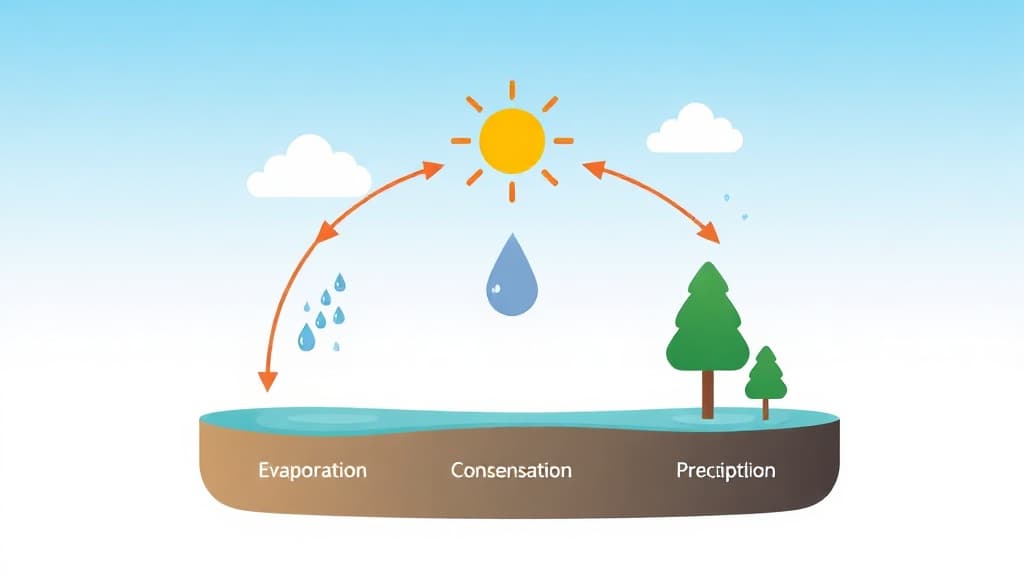
Evaporation, Condensation, Precipitation. Here are some of the most popular ways students use Water Cycle Explainer every day:
Makes science come alive with vivid, engaging explanations
Covers geography, geology, meteorology, and astronomy
Perfect for school projects and fuelling natural curiosity
Ask unlimited follow-up questions — the AI never loses patience or gives up on you
Works alongside any textbook, worksheet, or school resource
Water is everywhere—in clouds above you, soil beneath you, and every cell of your body—yet understanding how it continuously cycles through Earth's systems challenges even bright students. Applaa's Water Cycle Explainer makes this invisible process visible by guiding you through each stage: evaporation (water transforming into vapour from oceans and lakes), condensation (vapour becoming water droplets in clouds), precipitation (rain, snow, or hail falling), and collection (water returning to oceans and groundwater). This tool covers KS3 water cycle basics, GCSE Earth & Space climate and water, and A-Level geography water systems and hydrology. Input temperature, humidity, and location, and the tool models how much water evaporates, where clouds form, and where rain falls. See real satellite imagery of clouds forming, watch animations of water moving from ocean to atmosphere to land and back, and understand why some regions flood while others endure drought. Grasp the science behind weather, climate, and human water management—no memorisation, just clear physics and chemistry.
89%
GCSE students understand water cycle after using Applaa
14,000+
Water cycle simulations explored by UK learners monthly
100%
Free forever—learn Earth's water system
How to use the Water Cycle Explainer effectively
Observe the animated cycle showing evaporation from oceans and land, condensation in the atmosphere, precipitation, and collection in soil and oceans. Input temperature (which drives evaporation rate), humidity (which determines when clouds form), and wind patterns (which carry moisture-laden air). The tool calculates how much water evaporates per square metre per day, predicts where clouds form based on atmospheric conditions, and shows where precipitation falls. Use the 'real location' feature to model the cycle in your own region or compare tropical rainforests (extreme evaporation and precipitation) to deserts (minimal evaporation, no precipitation). This grounds the abstract cycle in reality you can observe.
Understand evaporation rate depends on temperature and surface area: warm ocean surfaces evaporate more water than cold lakes or soil
Remember condensation requires cooling (often from rising air expanding and cooling adiabatically) and condensation nuclei (dust particles that water vapour clings to)
Distinguish precipitation types by altitude and temperature: ice crystals at high altitude become sleet or snow; warmer clouds produce rain
Recognise that collection includes infiltration (water soaking into soil), percolation (moving through soil layers), and run-off (flowing downhill to streams)
Use the 'groundwater' module to understand that rainfall doesn't just run off—much soaks into aquifers, supplying wells and springs that sustain ecosystems
Compare water cycle rates in tropical rainforests (evapotranspiration from plants exceeds external precipitation), deserts (minimal evaporation, no rain), and temperate regions (balanced cycle)
Common mistakes with Water Cycle Explainer
The biggest error is thinking the cycle is simple and linear: water evaporates, condenses, precipitates, and stops. In reality, it's far more complex—water infiltrates soil, travels through aquifers for years or decades, emerges in springs, and travels underground rivers before reaching oceans. Students also forget that plants transpire water (releasing it from leaves), which is lumped into 'evapotranspiration'—this biological process is often ignored when it's substantial. Another trap: assuming all rainfall is precipitation; much moisture condenses as dew, frost, or fog before rain ever falls.
The water cycle is complex, not simple: water can remain in soil or groundwater for decades before evaporating or reaching the ocean—don't assume it's a fast circle
Evapotranspiration includes water lost from plants (transpiration) plus soil (evaporation); in vegetated regions, plants contribute more water to the atmosphere than soil does
Not all condensation is precipitation: dew, fog, and frost are condensation but produce no rain—they're equally important parts of the cycle in dry regions
Groundwater flow is not magical: water moves through soil and rock layers, following gravity and pressure gradients—it's geology, not mystery
Infiltration rates vary wildly: sandy soil infiltrates rapidly (water reaching aquifers quickly); clay soil infiltrates slowly (water runs off or sits in pools)
Sea level doesn't change from the water cycle (water in = water out on average) but local water availability varies enormously—deserts receive no precipitation while rainforests receive metres annually
Getting started
Master the Water Cycle in 4 Steps
Step 1
Download Applaa free and watch the animated water cycle—pause at each stage (evaporation, condensation, precipitation, collection) and describe what's happening in your own words
Step 2
Solve four GCSE water cycle questions from past papers, using the explainer to track water molecules from ocean to clouds to rain to groundwater and back
Step 3
Compare water cycles in three contrasting regions using the tool: a tropical rainforest, a desert, and a temperate forest—see how rates and processes differ
Step 4
Weekly observation: each morning, look at weather, clouds, and recent rainfall—use the explainer to model what's happening and predict tomorrow's weather based on atmospheric conditions
1 month free, then 50% off for 3 months — £4.99/mo
While Other Kids Get an AI Head Start, Is Yours Falling Behind?
Give your child the same AI app-building, exam prep and tutoring edge — free for the first month, no credit card needed.
Join 10,000+ students building their first AI-powered apps with Applaa
Frequently asked questions about Water Cycle Explainer
Where does all the water that evaporates from oceans actually go?
It enters the atmosphere as invisible water vapour. As air cools with altitude, vapour condenses into water droplets (clouds). These droplets eventually fall as precipitation—rain, snow, or hail. Most returns to oceans directly; some falls on land, soaks into soil, or runs off to streams. The tool tracks water molecules through this entire journey.
Why do some places get no rain while others flood?
Because atmospheric circulation patterns (jet streams, pressure systems, monsoons) steer moist air to some regions while steering it away from others. Mountains also force air to rise and cool, causing precipitation on windward slopes but leaving leeward sides dry. The tool models how geography shapes the water cycle.
Is the water in groundwater moving, or is it just sitting there?
It's moving slowly through rock and soil layers, following gravity and pressure gradients—typically metres per year, not metres per day. Some groundwater is ancient (thousands of years old) and has travelled vast distances underground. The tool visualises this underground flow, which is invisible but real.
Do I need to understand this for GCSE only, or does A-Level go deeper?
Both—GCSE covers the cycle basics; A-Level extends this to hydrology (river flow, flooding, erosion), water management (reservoirs, abstraction), and climate change impacts on water availability. The tool covers both levels and helps you progress from GCSE concepts to A-Level complexity.