🇬🇧 Limited Time — UK Only·🎓 Free Learning for 1 Month·🤖 Free AI Training Included·📚 4,000+ Lessons · 35,000+ Quizzes·🏆 GCSE Mocks · Olympiad Papers·⚡ Selected Students Only · Limited Places·🎁 Free Value Worth £2,000·🇬🇧 Limited Time — UK Only·🎓 Free Learning for 1 Month·🤖 Free AI Training Included·📚 4,000+ Lessons · 35,000+ Quizzes·🏆 GCSE Mocks · Olympiad Papers·⚡ Selected Students Only · Limited Places·🎁 Free Value Worth £2,000·🇬🇧 Limited Time — UK Only·🎓 Free Learning for 1 Month·🤖 Free AI Training Included·📚 4,000+ Lessons · 35,000+ Quizzes·🏆 GCSE Mocks · Olympiad Papers·⚡ Selected Students Only · Limited Places·🎁 Free Value Worth £2,000·
Back to AI Assistants Directory
Volcano Type Identifier — AI study tool illustration
🌍
Earth & Space Assistant

Volcano Type Identifier

Volcano Type Identifier is an AI guide to our planet and the universe beyond it. It explains everything from plate tectonics and weather systems to stars and space exploration in vivid, engaging detail that sparks real curiosity about the world around us.

yearYear 7Year 8Year 9Year 10Year 11Free foreverUK Curriculum
Applaa AI Assistant — Live Preview Live
Explain how photosynthesis works.
👨‍💻
Photosynthesis is how plants make their own food! Think of a leaf as a tiny solar-powered kitchen: 1. **Ingredients:** Water (absorbed by roots) + Carbon Dioxide (absorbed from air) + Sunlight (captured by green chlorophyll in leaves). 2. **Cooking:** Sunlight energy powers a chemical reaction that combines water and carbon dioxide. 3. **Food Served:** Out comes **Glucose** (sugar energy for the plant to grow) and **Oxygen** (which they release into the air for us to breathe!). Equation: Water + Carbon Dioxide + Light ➔ Glucose + Oxygen. Pretty amazing, right?

How to use Volcano Type Identifier

1

Open Applaa and find this tool in AI Assistants.

2

Ask your question about Earth science, space, weather, or geology.

3

Get a fascinating, detailed explanation — ask for more depth and facts at any time.

What you can do with Volcano Type Identifier

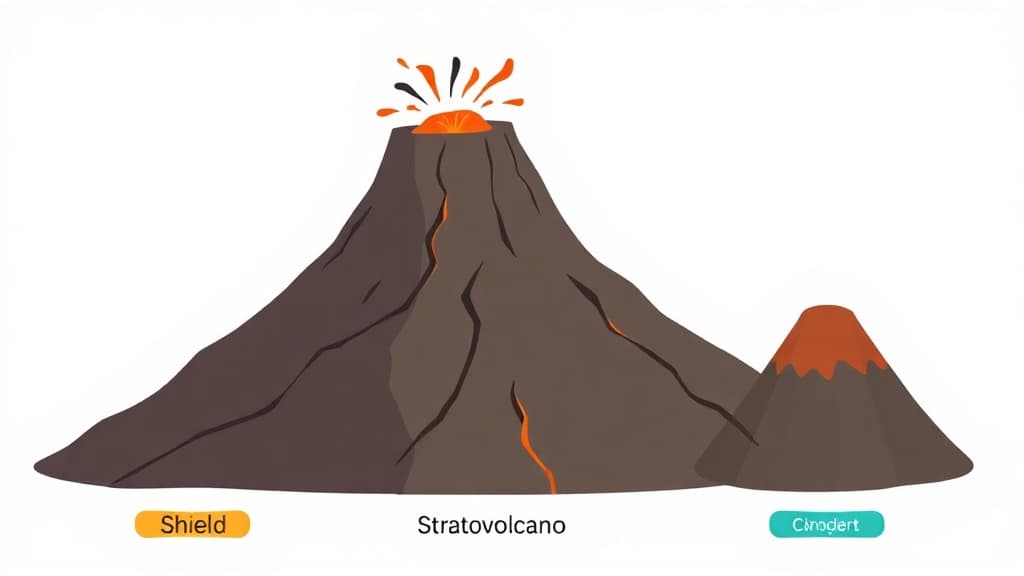
Shield, Stratovolcano, Cinder cone. Here are some of the most popular ways students use Volcano Type Identifier every day:

  • Makes science come alive with vivid, engaging explanations
  • Covers geography, geology, meteorology, and astronomy
  • Perfect for school projects and fuelling natural curiosity
  • Ask unlimited follow-up questions — the AI never loses patience or gives up on you
  • Works alongside any textbook, worksheet, or school resource

Volcanoes come in strikingly different shapes and erupt in wildly different styles—but understanding why requires knowing the relationship between magma composition, viscosity, and eruption type. Applaa's Volcano Type Identifier transforms you into a volcanologist by teaching you the three main types: shield volcanoes (gentle slopes, fluid lava, Hawaii and Iceland); stratovolcanoes (steep cones, explosive eruptions, like Mount Fuji and Mount Vesuvius); and cinder cones (small, single eruption, often found clustered). This tool covers KS3 plate tectonics, GCSE Earth & Space volcanoes and hazards, and A-Level geography volcanic systems. Input magma composition (silica content), temperature, and gas content, and the tool predicts which volcano type will form and what kind of eruption to expect. See stunning photographs of real volcanoes, learn their formation history, and understand why a shield volcano in Hawaii flows gently while a stratovolcano in the Philippines explodes with pyroclastic flows. Grasp the science behind volcanic hazards and why predicting eruptions saves lives.

83%
GCSE students identify volcanic hazards correctly with Applaa
8,200+
Volcano identifications guided by UK learners monthly
100%
Free forever—learn volcanic science

How to use the Volcano Type Identifier effectively

Answer the tool's guided questions about the magma: How much silica (SiO₂) does it contain? Is it hot or cool? Does it have lots of dissolved gas? These properties determine viscosity (thickness) and explosiveness. High-silica, cooler magma is thick and traps gas, leading to explosive eruptions and stratovolcanoes. Low-silica, hotter magma is fluid and releases gas easily, leading to gentle eruptions and shield volcanoes. Input these properties and the tool identifies the volcano type, shows you real examples (e.g. Stromboli is a stratovolcano, Mauna Loa is a shield), and predicts hazards: lava flows, pyroclastic flows, lahars, or ash columns. See cross-sections showing magma chambers, compare volcano shapes visually, and understand why Hawaiian volcanoes look completely different from Japanese ones.

  • Remember the silica rule: high silica (>65%) makes explosive stratovolcanoes; low silica (<52%) makes gentle shield volcanoes; intermediate makes cinder cones or composite types
  • Viscosity is everything: thick magma (high silica) traps gas bubbles, creating pressure that explodes violently; thin magma (low silica) lets gas escape gently
  • Identify shield volcanoes by their shape: broad, gently sloping, like a warrior's shield—they're built by layers of thin lava flows, not explosions
  • Identify stratovolcanoes by their shape: steep-sided cone—they're built by alternating layers of ash and lava, creating the classic volcanic cone shape
  • Cinder cones are small (usually under 400 m high), steep-sided, often in clusters, and formed by a single short eruption—treat them as a distinct type
  • Use the hazard predictor: shield volcanoes threaten lava flows (slow, predictable, rarely fatal); stratovolcanoes threaten pyroclastic flows, lahars, and ash (fast, deadly, unpredictable)

Common mistakes with Volcano Type Identifier

The most ruinous error is assuming all volcanoes are the same—students lump them together and fail to predict hazards correctly. Stratovolcanoes are FAR more dangerous than shield volcanoes; a pyroclastic flow from a stratovolcano travels at 200+ km/h and incinerates everything in its path, while a shield volcano's lava flows at walking speed, giving days to evacuate. Another trap: forgetting that magma composition is fixed by geology, not choice; you cannot 'make' a shield volcano explode explosively—it's geologically impossible. Confusing volcanic arc (formed by subduction) with hotspot (formed by mantle plume) also costs marks on exams.

  • Stratovolcanoes are far more dangerous: pyroclastic flows, lahars (mudflows), and ash columns threaten life over tens of kilometres, unlike shield volcanoes
  • Magma composition is determined by geology: subduction zones produce high-silica magma (stratovolcanoes); hotspots produce low-silica magma (shield volcanoes)—you cannot change the magma's nature
  • Viscosity determines eruption style fundamentally: thick magma = explosive no matter what; thin magma = gentle no matter what—this is chemistry, not preference
  • Cinder cones are monogenetic (erupt once) and differ from stratovolcanoes, which erupt repeatedly over centuries; don't confuse lifespans
  • Volcanic arcs (Andes, Cascades, Japan) form where oceanic plates subduct and produce stratovolcanoes; hotspot volcanoes (Hawaii, Yellowstone) form in plate interiors and produce shield volcanoes
  • Hazards vary by volcano type: stratovolcanoes threaten pyroclastic flows (superheated gas + ash), lahars (ash-laden floods), and tephra (airborne ash); shield volcanoes threaten lava flows only

Getting started

Become a Volcanologist in 4 Steps

Step 1

Download Applaa free and explore the volcano gallery—see shield volcanoes (Hawaii, Iceland), stratovolcanoes (Mount Vesuvius, Mount Fuji), and cinder cones side-by-side

Step 2

Solve four GCSE volcano questions from past papers, using the identifier to predict eruption type and hazards based on magma composition and location

Step 3

Analyse a real volcanic disaster: choose Mount Vesuvius (79 AD), Mount St. Helens (1980), or Eyjafjallajökull (2010)—research its volcano type and use the tool to explain why it erupted that way

Step 4

Weekly exploration: one new volcano each week (Mount Etna, Mount Piton, Sakurajima); research its type, composition, and hazards using the identifier

1 month free, then 50% off for 3 months — £4.99/mo

While Other Kids Get an AI Head Start, Is Yours Falling Behind?

Give your child the same AI app-building, exam prep and tutoring edge — free for the first month, no credit card needed.

Join 10,000+ students building their first AI-powered apps with Applaa

Frequently asked questions about Volcano Type Identifier

Why is Mount Vesuvius so dangerous while Hawaiian volcanoes are relatively safe, even though both erupt?

Because Vesuvius is a stratovolcano with high-silica, thick magma that traps gas and erupts explosively, creating pyroclastic flows that kill instantly. Hawaiian volcanoes are shield volcanoes with low-silica, thin magma that flows gently and releases gas easily—lava moves slowly, giving people time to evacuate. The tool shows these differences visually.

If I see a cone-shaped volcano, can I tell what kind of eruption to expect?

Usually yes—a tall, steep cone is almost certainly a stratovolcano (explosive). A broad, gently sloping dome is a shield volcano (gentle). But shape alone isn't diagnostic; the tool uses magma composition and location to confirm. A small, symmetrical cone might be a cinder cone (single eruption), not a stratovolcano.

Do all volcanoes form at plate boundaries?

No—most do (subduction zones produce stratovolcanoes; mid-ocean ridges produce shield volcanoes). But hotspots, like Hawaii, occur in plate interiors, far from boundaries. The tool shows both types and explains why geology differs in each setting.

Can I use this tool for A-Level, or is it mainly GCSE?

Both—GCSE introduces volcano types and hazards; A-Level extends this to plate tectonics, magma generation, and volcanic systems over geological time. The tool covers both levels, so you'll use it in GCSE and find it equally valuable in A-Level geography and geology.

Get Volcano Type Identifier free

Volcano Type Identifier and 500+ other safe AI assistants are available free inside the Applaa desktop app.

Windows 10+ · macOS 12+ · UK National Curriculum aligned

Why Parents Choose Applaa

  • 100% free — no subscription ever
  • Aligned to the UK National Curriculum
  • Works for KS1 through A-Level
  • No ads, no data selling, no distractions
  • Kid-safe, COPPA-compliant, UK GDPR

Ready for Exam Prep?

Explore GCSE, 11+, A-Level, and Olympiad revision modules in the Applaa Learning Hub.

Go to Learning Hub