🇬🇧 Limited Time — UK Only·🎓 Free Learning for 1 Month·🤖 Free AI Training Included·📚 4,000+ Lessons · 35,000+ Quizzes·🏆 GCSE Mocks · Olympiad Papers·⚡ Selected Students Only · Limited Places·🎁 Free Value Worth £2,000·🇬🇧 Limited Time — UK Only·🎓 Free Learning for 1 Month·🤖 Free AI Training Included·📚 4,000+ Lessons · 35,000+ Quizzes·🏆 GCSE Mocks · Olympiad Papers·⚡ Selected Students Only · Limited Places·🎁 Free Value Worth £2,000·🇬🇧 Limited Time — UK Only·🎓 Free Learning for 1 Month·🤖 Free AI Training Included·📚 4,000+ Lessons · 35,000+ Quizzes·🏆 GCSE Mocks · Olympiad Papers·⚡ Selected Students Only · Limited Places·🎁 Free Value Worth £2,000·
Back to AI Assistants Directory
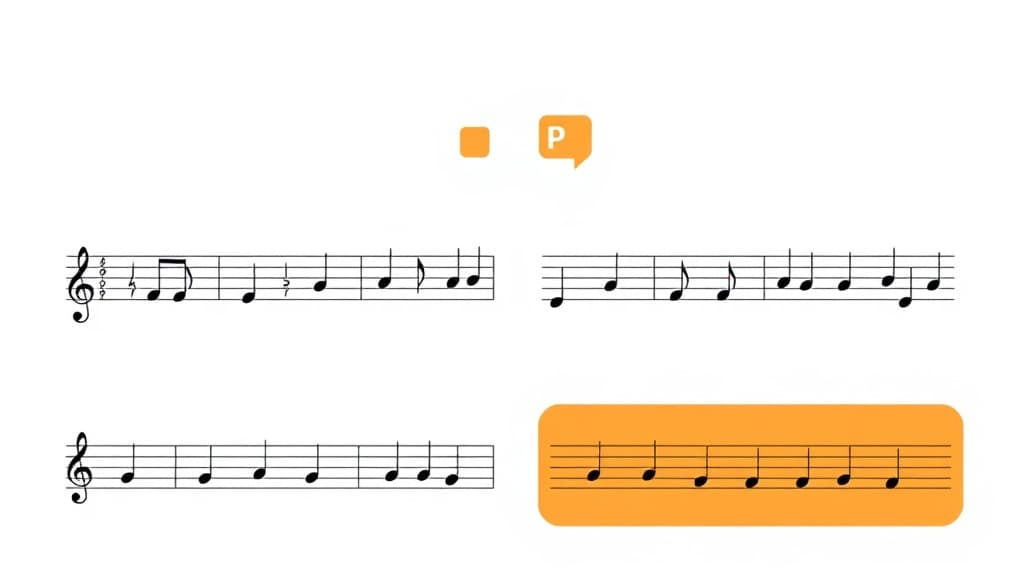
Music Theory Explainer — AI study tool illustration
🎼
Music Learning Assistant

Music Theory Explainer

Music Theory Explainer is a personalised music practice companion inside Applaa. Whether learning an instrument for the first time, reading sheet music, or deepening music theory knowledge, it gives patient, clear guidance that builds real, lasting musical ability.

yearYear 7Year 8Year 9Year 10Year 11Free foreverUK Curriculum
Applaa AI Assistant — Live Preview Live
Help me understand this topic for my school revision.
👨‍💻
I'd love to help! Let's break this down into bite-sized pieces. First, tell me what year group you are in and if you have any homework questions. I will explain it step-by-step with real-world examples, and we can do a quick quiz at the end to make sure it makes perfect sense!

How to use Music Theory Explainer

1

Open Applaa and go to AI Assistants.

2

Tell it your instrument, current skill level, and what you're practising.

3

Get tailored exercises, notation help, and technique tips to make genuine, measurable progress.

What you can do with Music Theory Explainer

Key signatures, time signatures. Here are some of the most popular ways students use Music Theory Explainer every day:

  • Makes music theory and notation genuinely accessible
  • Supports any instrument at any level — from day one
  • Great for self-learners, music students, and exam preparation
  • Ask unlimited follow-up questions — the AI never loses patience or gives up on you
  • Works alongside any textbook, worksheet, or school resource

Music theory can feel abstract and disconnected from real music—scales, intervals, key signatures, time signatures all feel like arbitrary rules until suddenly they make sense. Applaa's Music Theory Explainer transforms theory from confusing notation into intuitive understanding by connecting concepts to actual sound. Whether you're studying for ABRSM grade exams, GCSE Music, Trinity Guildhall grades, or simply want to understand why songs are structured the way they are, this tool breaks down complex concepts like major and minor keys, chord progressions, and rhythm into clear, visual explanations. You'll see how key signatures work, hear why certain progressions sound resolved while others feel unfinished, and understand how theory serves composers and performers. With Applaa's interactive demonstrations, music theory shifts from memorization to genuine comprehension—exactly what examiners reward.

13,000+
Music students mastering theory
12 major scales
Key signatures to understand
100%
Free theory education access

How to use Music Theory Explainer effectively

Start with foundational concepts: the major scale, intervals (distances between notes), and how scales build chords. The tool plays musical examples so you hear the sound alongside the visual representation. Study key signatures by understanding how scales work—C major has no sharps or flats because it uses all white piano keys, F major adds one flat (Bb) to shift the scale pattern, and so on. Once key signatures click, time signatures become simpler—they're just organizational patterns telling you how many beats per measure. Learn chord progressions by hearing them: I–IV–V–I appears in thousands of songs, and the tool demonstrates why this progression feels complete and satisfying. Use the tool's interactive keyboard to play examples yourself, connecting visual theory to physical motion and sound. Practice identifying intervals by ear and on staff notation—this dual skill is tested in music exams.

  • Learn the major scale pattern and build all other scales from it
  • Understand intervals as distances between notes; learn their qualities through hearing and playing
  • Study key signatures by learning which notes are raised/lowered and why
  • Recognize that time signatures describe rhythm organization
  • Learn common chord progressions by hearing them in real songs
  • Develop interval ear-training: hear intervals and identify them

Common mistakes with Music Theory Explainer

The biggest mistake is memorizing theory rules without understanding why they exist. Key signatures make sense once you understand scales, but memorizing without knowing why leads to forgetting. Another error is treating theory as separate from actual music—studying scales in isolation, never hearing them in context. Students often confuse relative major and minor keys or don't recognize when composers break traditional rules deliberately for effect. Many struggle with rhythm because they think time signatures are arbitrary rather than understanding beat subdivision. Chord function confusion is common—students memorize definitions without grasping how these roles create expectation and resolution. Finally, failing to use the keyboard and audio features means theory stays abstract instead of becoming intuitive.

  • Never memorize theory without understanding why—if you can't explain a rule, you don't understand it
  • Connect theory to actual music: hear scales in songs, see progressions in pieces you know
  • Remember relative major and minor share key signatures; train your ear to distinguish them by sound
  • Understand time signatures describe beat patterns, not arbitrary notation
  • Learn chord function through hearing progressions resolve, not through definitions
  • Use the tool's keyboard and audio features—music theory must sound right to be real

Getting started

Getting started with Music Theory Explainer

Step 1

Download Applaa free and start with the major scale module—learn the pattern and play it

Step 2

Study key signatures by building scales starting from different notes

Step 3

Explore intervals by identifying them by ear and on staff notation

Step 4

Learn one chord progression (I–IV–V–I) by hearing it in multiple songs

1 month free, then 50% off for 3 months — £4.99/mo

While Other Kids Get an AI Head Start, Is Yours Falling Behind?

Give your child the same AI app-building, exam prep and tutoring edge — free for the first month, no credit card needed.

Join 10,000+ students building their first AI-powered apps with Applaa

Frequently asked questions about Music Theory Explainer

Why do we need key signatures if we can just write sharps and flats next to notes?

Key signatures prevent visual clutter and tell you instantly what 'home' note feels like. In C major, no key signature means you're in C and F# is rare. In F major, one flat means Bb is constant throughout. This organization helps performers read faster and understand the piece's harmonic centre immediately.

What's the difference between major and minor keys? They use the same notes in relative keys.

Relative major and minor keys do share the same key signature (e.g. C major and A minor both have no sharps), but they sound completely different. C major sounds bright; A minor sounds dark. The difference is which note feels like 'home'—in C major it's C, in A minor it's A. You hear the emotional difference immediately.

Do I need to understand all this theory for GCSE Music, or can I just memorize key facts?

Examiners test understanding, not just memorization. You might memorize that F major has one flat, but if you can't explain why or spot errors in a key signature, you'll lose marks. Understanding takes longer initially but pays off enormously in exams and allows you to apply knowledge to new situations.

I can read music but I don't understand why composers choose certain keys or progressions. Can the tool help?

Yes. The tool explains function (why V resolves to I, why vi works after I), showing you the logic composers use. Once you understand this language, you'll appreciate pieces more deeply and your own musical choices will improve. This is especially valuable for GCSE Music composition.

Get Music Theory Explainer free

Music Theory Explainer and 500+ other safe AI assistants are available free inside the Applaa desktop app.

Windows 10+ · macOS 12+ · UK National Curriculum aligned

Why Parents Choose Applaa

  • 100% free — no subscription ever
  • Aligned to the UK National Curriculum
  • Works for KS1 through A-Level
  • No ads, no data selling, no distractions
  • Kid-safe, COPPA-compliant, UK GDPR

Ready for Exam Prep?

Explore GCSE, 11+, A-Level, and Olympiad revision modules in the Applaa Learning Hub.

Go to Learning Hub