🇬🇧 Limited Time — UK Only·🎓 Free Learning for 1 Month·🤖 Free AI Training Included·📚 4,000+ Lessons · 35,000+ Quizzes·🏆 GCSE Mocks · Olympiad Papers·⚡ Selected Students Only · Limited Places·🎁 Free Value Worth £2,000·🇬🇧 Limited Time — UK Only·🎓 Free Learning for 1 Month·🤖 Free AI Training Included·📚 4,000+ Lessons · 35,000+ Quizzes·🏆 GCSE Mocks · Olympiad Papers·⚡ Selected Students Only · Limited Places·🎁 Free Value Worth £2,000·🇬🇧 Limited Time — UK Only·🎓 Free Learning for 1 Month·🤖 Free AI Training Included·📚 4,000+ Lessons · 35,000+ Quizzes·🏆 GCSE Mocks · Olympiad Papers·⚡ Selected Students Only · Limited Places·🎁 Free Value Worth £2,000·
Back to AI Assistants Directory
Mitosis & Meiosis Tutor — AI study tool illustration
🧬
Biology & Life Science Assistant

Mitosis & Meiosis Tutor

Mitosis & Meiosis Tutor turns complex biology into clear, memorable explanations your child can actually understand. It uses simple language and helpful analogies to break down every topic — from cell structure and genetics to ecosystems and the human body.

yearYear 7Year 8Year 9Year 10Year 11Free foreverUK Curriculum
Applaa AI Assistant — Live Preview Live
Explain how photosynthesis works.
👨‍💻
Photosynthesis is how plants make their own food! Think of a leaf as a tiny solar-powered kitchen: 1. **Ingredients:** Water (absorbed by roots) + Carbon Dioxide (absorbed from air) + Sunlight (captured by green chlorophyll in leaves). 2. **Cooking:** Sunlight energy powers a chemical reaction that combines water and carbon dioxide. 3. **Food Served:** Out comes **Glucose** (sugar energy for the plant to grow) and **Oxygen** (which they release into the air for us to breathe!). Equation: Water + Carbon Dioxide + Light ➔ Glucose + Oxygen. Pretty amazing, right?

How to use Mitosis & Meiosis Tutor

1

Open Applaa and select this tool from AI Assistants.

2

Describe the biology topic you're studying or paste a question from your textbook.

3

Get a clear explanation with real-world examples — ask any follow-up question as many times as needed.

What you can do with Mitosis & Meiosis Tutor

Cell division stages explained. Here are some of the most popular ways students use Mitosis & Meiosis Tutor every day:

  • Makes complex biology genuinely accessible at every level
  • Covers GCSE, A-Level, and IB Biology comprehensively
  • Great for revision, homework help, and science fair projects
  • Ask unlimited follow-up questions — the AI never loses patience or gives up on you
  • Works alongside any textbook, worksheet, or school resource

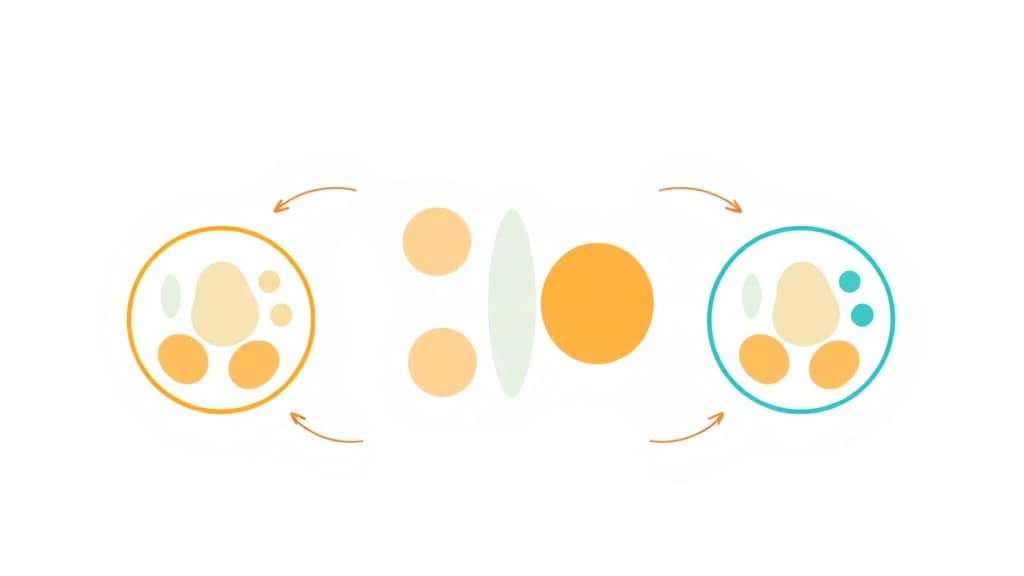
The Mitosis & Meiosis Tutor breaks down two of the most critical—and often confusing—cell division processes that underpin growth, repair, and sexual reproduction. GCSE and A-Level Biology devote substantial time to these processes, yet static textbook diagrams often leave students tangled: What's the difference between mitosis and meiosis? Why does meiosis reduce chromosome numbers? How do sister chromatids separate? Applaa's Mitosis & Meiosis Tutor animates every stage—prophase, metaphase, anaphase, telophase—with colour-coded chromosomes, spindle fibres, and centrosomes so you visually track what happens. You'll see mitosis produce two identical daughter cells (crucial for growth and healing) and meiosis produce four genetically unique gametes (sperm and eggs). The tutor explains why these processes are different (mitosis maintains chromosome number; meiosis halves it) and why both matter for life. By animating the molecular choreography—centrosomes pulling chromosomes, nuclear envelopes dissolving, cytokinesis dividing the cytoplasm—this tool transforms abstract concepts into vivid, memorable processes.

8
Stages animated step-by-step with colour-coded visuals
50+
Practice scenarios and exam-style questions
100%
Covers GCSE, IGCSE, and A-Level content

How to use Mitosis & Meiosis Tutor effectively

Start with the 'Mitosis Basics' module. Watch the full animation cycle without notes, getting a visual sense of what happens. Then pause on each stage: prophase (chromosomes condense), metaphase (they align at the cell's centre), anaphase (sister chromatids separate and move to poles), telophase (nuclei reform), cytokinesis (cytoplasm divides). At each stage, observe specific details: the spindle fibres attached to centromeres, the breakdown of the nuclear envelope, the placement of chromosomes. Next, move to 'Meiosis Overview' and watch a full cycle. Then compare the two: mitosis has one division (producing two cells); meiosis has two divisions (producing four cells). Meiosis includes a unique crossing-over phase (recombination) where chromosomes exchange segments—this creates genetic diversity. Finally, quiz yourself with 'Stage Identification': you're shown a cell image and must name the stage and process (mitosis or meiosis). This is exactly what examiners test.

  • Distinguish the key difference: mitosis produces two genetically identical cells; meiosis produces four genetically unique ones
  • Recognise that sister chromatids (copies held by a centromere) separate during anaphase in both processes, but chromosome pairs separate only in meiosis II
  • Understand why meiosis halves chromosome number: a diploid cell (2n) becomes haploid gametes (n); when gametes fuse at fertilisation, diploidy is restored
  • Note that crossing-over (recombination) occurs only in meiosis I, shuffling alleles and increasing genetic variation—crucial for evolution
  • Trace specific cell structures: centrosomes (organise spindle), centrioles (in animal cells, absent in plants), spindle fibres (kinetochore microtubules pull chromosomes)
  • Link the processes to life: mitosis drives growth in children and wound healing; meiosis produces sperm and eggs, enabling sexual reproduction and genetic mixing

Common mistakes with Mitosis & Meiosis Tutor

The most frequent error is confusing mitosis and meiosis outright—students sometimes flip their functions or mix stage names. Another trap is thinking sister chromatids are 'separate chromosomes'—they're two copies held by a centromere until anaphase separates them. Many learners also miss the significance of crossing-over, viewing meiosis as a simple halving process rather than a generator of genetic diversity. UK students often overlook the biological context: mitosis isn't just a stage to memorise; it's why children grow, wounds heal, and cancers develop (uncontrolled mitosis). Meiosis isn't an abstract process; it's why siblings aren't identical despite having the same parents (each egg and sperm is unique). Finally, some students struggle to count chromosomes at each stage, confusing chromosome number (how many physical structures) with DNA amount (how many copies of each chromosome).

  • Don't confuse sister chromatids with homologous chromosomes: chromatids are copies of one chromosome; homologs are maternal and paternal versions of the same chromosome
  • Remember: mitosis = growth; meiosis = gamete formation. Memorising stages without purpose makes exams harder
  • Avoid assuming 'chromosome number halves' is the only important feature of meiosis—genetic shuffling via crossing-over and independent assortment is equally crucial
  • Track DNA amount through each stage: before division, DNA is replicated (2n becomes 4n temporarily); after, it's 2n again or n in gametes
  • Link mitosis errors to cancer: uncontrolled mitosis (skipping checkpoints) drives tumour growth—this is why cell cycle control is examined at A-Level
  • Recognise that plant and animal cells divide differently: animal cells have centrosomes; plant cells lack them and use microtubule organising centres instead

Getting started

Getting started with Mitosis & Meiosis Tutor

Step 1

Download Applaa free and open 'Mitosis & Meiosis Tutor' under Biology & Life Science

Step 2

Watch the full mitosis animation without notes, then replay it stage-by-stage, pausing to sketch prophase, metaphase, anaphase, and telophase

Step 3

Watch the full meiosis animation and identify the two divisions and the crossing-over phase; note why meiosis produces four cells with half the chromosomes

Step 4

Take the 'Stage Identification' quiz daily for a week: this is the most common exam question format, and practice builds confidence

1 month free, then 50% off for 3 months — £4.99/mo

While Other Kids Get an AI Head Start, Is Yours Falling Behind?

Give your child the same AI app-building, exam prep and tutoring edge — free for the first month, no credit card needed.

Join 10,000+ students building their first AI-powered apps with Applaa

Frequently asked questions about Mitosis & Meiosis Tutor

Why do examiners always ask us to draw cells in specific stages?

Because drawing forces you to understand, not just memorise. By sketching prophase (when you draw the spindle forming and chromosomes condensing), you engage the motor cortex and memory simultaneously. Examiners use drawings to check whether you can identify chromosome position, spindle attachment, and nuclear envelope status—markers of the true stage.

How does crossing-over in meiosis affect genetic variation?

Crossing-over swaps segments of homologous chromosomes, shuffling alleles. This, combined with independent assortment (random chromosome pairs to gametes), means each sperm and egg is genetically unique. That's why siblings aren't identical despite the same parents. This process is fundamental to evolution and A-Level genetics questions.

Are there differences between mitosis in plant and animal cells?

Yes. Animal cells have centrosomes with centrioles that organise the spindle; plant cells lack centrioles but still use spindle fibres anchored at poles. Also, plant cells form a cell plate during cytokinesis (building a new cell wall); animal cells have a cleavage furrow (membrane pinches inward). Our tutor shows both to prepare you for any exam question.

How does uncontrolled mitosis relate to cancer?

Cancer cells divide repeatedly without the checkpoint controls that normally pause mitosis if something is wrong (e.g., DNA damage). Tumours are uncontrolled mitosis. A-Level biology asks you to explain how mutations in genes controlling the cell cycle (like p53) allow cells to skip checkpoints and divide endlessly. The Tutor links normal mitosis to this pathology so you grasp the contrast.

Get Mitosis & Meiosis Tutor free

Mitosis & Meiosis Tutor and 500+ other safe AI assistants are available free inside the Applaa desktop app.

Windows 10+ · macOS 12+ · UK National Curriculum aligned

Why Parents Choose Applaa

  • 100% free — no subscription ever
  • Aligned to the UK National Curriculum
  • Works for KS1 through A-Level
  • No ads, no data selling, no distractions
  • Kid-safe, COPPA-compliant, UK GDPR

Ready for Exam Prep?

Explore GCSE, 11+, A-Level, and Olympiad revision modules in the Applaa Learning Hub.

Go to Learning Hub