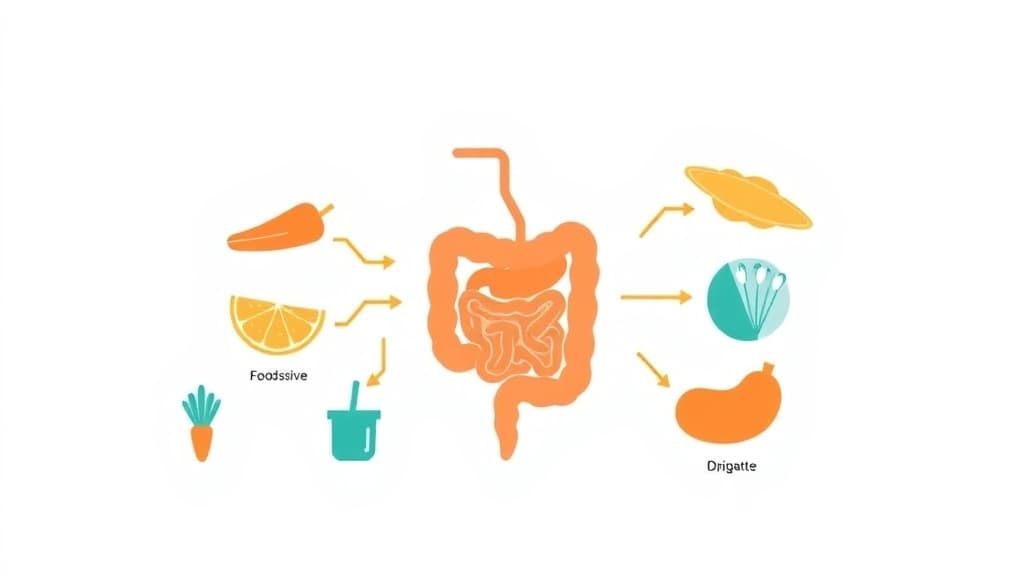
Digestive System Guide turns complex biology into clear, memorable explanations your child can actually understand. It uses simple language and helpful analogies to break down every topic — from cell structure and genetics to ecosystems and the human body.
Photosynthesis is how plants make their own food! Think of a leaf as a tiny solar-powered kitchen:
1. **Ingredients:** Water (absorbed by roots) + Carbon Dioxide (absorbed from air) + Sunlight (captured by green chlorophyll in leaves).
2. **Cooking:** Sunlight energy powers a chemical reaction that combines water and carbon dioxide.
3. **Food Served:** Out comes **Glucose** (sugar energy for the plant to grow) and **Oxygen** (which they release into the air for us to breathe!).
Equation: Water + Carbon Dioxide + Light ➔ Glucose + Oxygen. Pretty amazing, right?
How to use Digestive System Guide
1
Open Applaa and select this tool from AI Assistants.
2
Describe the biology topic you're studying or paste a question from your textbook.
3
Get a clear explanation with real-world examples — ask any follow-up question as many times as needed.
What you can do with Digestive System Guide
How food moves through your body. Here are some of the most popular ways students use Digestive System Guide every day:
Makes complex biology genuinely accessible at every level
Covers GCSE, A-Level, and IB Biology comprehensively
Great for revision, homework help, and science fair projects
Ask unlimited follow-up questions — the AI never loses patience or gives up on you
Works alongside any textbook, worksheet, or school resource
The Digestive System Guide traces your food's incredible journey from mouth to faeces, explaining how mechanical and chemical breakdown, absorption, and elimination work in concert to fuel your body. GCSE Biology covers the digestive system in depth—students must understand enzyme action, organ functions, and nutrient absorption—yet many treat it as an abstract tube rather than a dynamic process. Applaa's Digestive System Guide animates food movement through oesophagus, stomach, small intestine, and large intestine, showing how saliva, pepsin, lipase, and other enzymes chemically break down proteins, fats, and carbohydrates. You'll see how the small intestine's villi dramatically increase surface area for nutrient absorption, and why the large intestine reabsorbs water to prevent dehydration. The guide emphasises the role of the liver (produces bile), pancreas (produces digestive enzymes and regulates blood glucose), and stomach lining (secretes mucus to prevent self-digestion). With real-world examples—lactose intolerance, ulcers, coeliac disease—the guide connects anatomy to health. Essential for GCSE and A-Level Biology, and valuable for food science and dietetics pathways.
6
Major digestive organs animated with enzyme and nutrient tracking
15+
Digestive enzymes profiled with substrates and optimal conditions
100%
Free for GCSE and A-Level learners
How to use Digestive System Guide effectively
Start by selecting 'Food Journey' and watch animation of a complete meal (say, a sandwich with fruit) moving through the digestive system. Pause at each organ: the mouth (mechanical and chemical breakdown by salivary amylase); the stomach (churning, acid, and pepsin digesting protein); the small intestine (bile and pancreatic enzymes digest fats and remaining carbs/proteins; villi absorb nutrients); the large intestine (water reabsorption, fibre fermentation). Next, explore the 'Enzyme Action' module: select an enzyme (amylase, protease, lipase) and see what it breaks down, where it's produced, and what conditions optimise its action (pH, temperature). Use the 'Nutrient Tracking' feature to follow glucose, amino acids, and fatty acids from food to absorption to transport. Then study the 'Accessory Organs': the liver produces bile (emulsifies fats), the pancreas produces amylase, protease, and lipase (and insulin for glucose control), the gallbladder stores bile. Finally, examine case studies: lactose intolerance (lack of lactase enzyme), coeliac disease (immune attack on gluten), ulcers (stomach lining erosion).
Learn the order of organs: mouth → oesophagus → stomach → small intestine (duodenum, jejunum, ileum) → large intestine (colon, rectum) → anus
Understand enzyme specificity: amylase breaks starch into maltose; protease breaks proteins into peptides and amino acids; lipase breaks fats into glycerol and fatty acids
Know the optimal conditions: salivary amylase works best at neutral pH; pepsin requires acidic stomach; small intestine enzymes prefer slightly alkaline pH from pancreatic bicarbonate
Visualise the small intestine's structure: villi increase surface area ~30-fold; microvilli increase it further; this maximises nutrient absorption
Trace nutrient fates: glucose is absorbed into bloodstream and transported to liver for immediate use or storage; amino acids are transported for protein synthesis; fatty acids are packaged into chylomicrons
Understand the liver's role in metabolism: it stores glucose as glycogen, synthesises plasma proteins, breaks down toxins, produces cholesterol, and makes bile
Common mistakes with Digestive System Guide
Many students think 'digestion' means just breakdown in the mouth and stomach; in reality, most chemical digestion occurs in the small intestine via pancreatic enzymes. Another trap is ignoring the accessory organs: the liver and pancreas are easy to overlook, but they're critical—without bile, fats can't be digested; without pancreatic bicarbonate, enzymes don't work in the acidic duodenum. UK learners sometimes assume all ingested food is absorbed; in reality, indigestible fibre passes through unchanged, and some nutrients aren't fully absorbed if conditions are unfavourable. Many also miss the link between digestion and metabolism: digestion breaks nutrients down; metabolism uses them for energy and growth. Finally, some students conflate the gut's microbiome (bacteria) with the digestive system itself—whilst bacteria aid fibre fermentation and vitamin synthesis, they're a separate ecosystem within the digestive tract.
Don't assume all digestion happens in the stomach: the stomach initiates protein breakdown, but the small intestine is where most nutrient breakdown and absorption occurs
Remember the role of bile: it emulsifies fats (breaks them into droplets) so lipase can act; bile is produced by the liver, stored in the gallbladder, and released into the duodenum
Understand that enzymes work only in narrow pH ranges: pepsin works in acidic stomach; trypsin works in slightly alkaline small intestine; shifting pH inactivates them
Recognise that the villi and microvilli structure is key to nutrient absorption: a large surface area allows efficient uptake before food residue reaches the large intestine
Link digestive efficiency to health: coeliac disease damages villi, reducing absorption; crohn's disease inflames the intestine; IBS affects motility
Avoid thinking the large intestine is 'waste disposal': it reabsorbs water, salts, and vitamins produced by gut bacteria—essential functions for hydration and health
Getting started
Getting started with Digestive System Guide
Step 1
Download Applaa free and open 'Digestive System Guide' under Biology & Life Science
Step 2
Watch the full 'Food Journey' animation with a typical meal to see food move from mouth to faeces; note where each nutrient type is digested
Step 3
Study the 'Enzyme Action' module: for each enzyme (amylase, pepsin, trypsin, lipase), note its substrate, location, and optimal pH
Step 4
Trace one nutrient (glucose, amino acid, or fatty acid) from the food you ate this morning through digestion, absorption, and transport to cells
1 month free, then 50% off for 3 months — £4.99/mo
While Other Kids Get an AI Head Start, Is Yours Falling Behind?
Give your child the same AI app-building, exam prep and tutoring edge — free for the first month, no credit card needed.
Join 10,000+ students building their first AI-powered apps with Applaa
Frequently asked questions about Digestive System Guide
Why do GCSE questions always ask about the small intestine's structure?
Because the small intestine's enormous surface area (villi and microvilli) is the key to why most nutrient absorption happens there rather than the stomach or large intestine. Understanding that structure determines function is a key biological principle. Examiners test this by asking you to explain why the small intestine absorbs nutrients so efficiently.
What's the difference between mechanical and chemical digestion?
Mechanical digestion is physical breakdown: teeth chew, the stomach churns. Chemical digestion uses enzymes to break chemical bonds: amylase breaks starch, pepsin breaks protein. Both are essential—mechanical digestion increases surface area for enzymes to act; enzymes complete the breakdown into absorbable units. Our guide animates both processes side-by-side.
How does the guide explain coeliac disease for health-focused GCSE questions?
Coeliac disease is autoimmune: gluten (a protein in wheat) triggers an immune attack on the small intestine's villi, damaging them and reducing nutrient absorption. Our guide shows this damage visually and explains why sufferers must avoid gluten entirely. It's a perfect example of how digestive anatomy links to health conditions.
Can I use the enzyme optimal conditions to predict what happens if pH changes?
Yes. If stomach contents aren't acidic enough (due to acid-reducing drugs), pepsin doesn't work and protein digestion stalls. If the small intestine is too acidic (pancreatic bicarbonate isn't released), trypsin is deactivated. Our guide teaches you to predict enzyme activity given conditions—a common A-Level exam question. Understanding specificity means you can reason through unfamiliar scenarios.