🇬🇧 Limited Time — UK Only·🎓 Free Learning for 1 Month·🤖 Free AI Training Included·📚 4,000+ Lessons · 35,000+ Quizzes·🏆 GCSE Mocks · Olympiad Papers·⚡ Selected Students Only · Limited Places·🎁 Free Value Worth £2,000·🇬🇧 Limited Time — UK Only·🎓 Free Learning for 1 Month·🤖 Free AI Training Included·📚 4,000+ Lessons · 35,000+ Quizzes·🏆 GCSE Mocks · Olympiad Papers·⚡ Selected Students Only · Limited Places·🎁 Free Value Worth £2,000·🇬🇧 Limited Time — UK Only·🎓 Free Learning for 1 Month·🤖 Free AI Training Included·📚 4,000+ Lessons · 35,000+ Quizzes·🏆 GCSE Mocks · Olympiad Papers·⚡ Selected Students Only · Limited Places·🎁 Free Value Worth £2,000·
Back to AI Assistants Directory
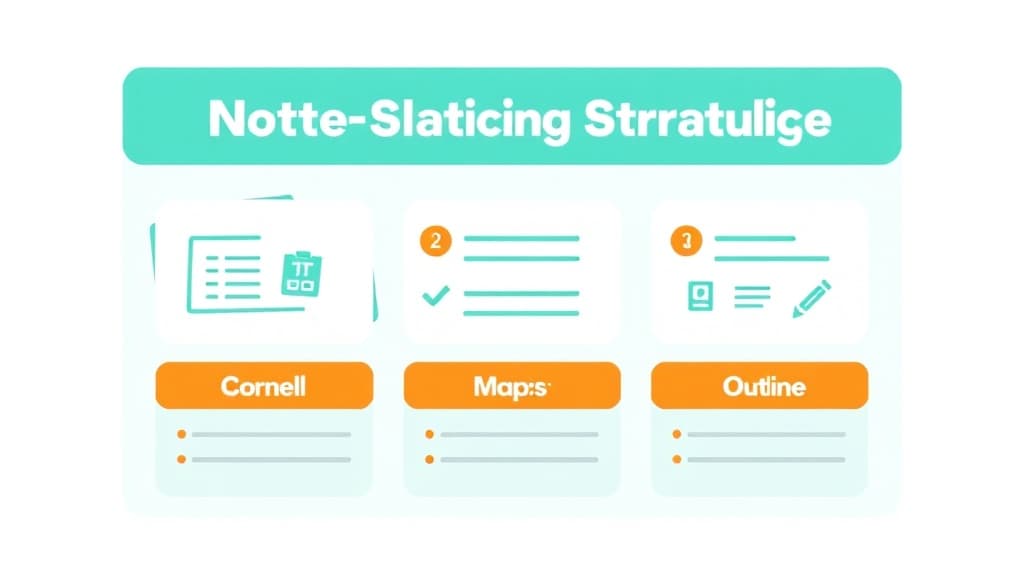
Note-Taking Strategy Guide — AI study tool illustration
📝
Study Skills Assistant

Note-Taking Strategy Guide

Note-Taking Strategy Guide teaches your child to work smarter — not just harder. It introduces proven study techniques, time management strategies, and memory methods used by top students worldwide. The right habits learned now make every subject easier for life.

yearYear 6Year 7Year 8Year 9Year 10Year 11Free foreverUK Curriculum
Applaa AI Assistant — Live Preview Live
Help me understand this topic for my school revision.
👨‍💻
I'd love to help! Let's break this down into bite-sized pieces. First, tell me what year group you are in and if you have any homework questions. I will explain it step-by-step with real-world examples, and we can do a quick quiz at the end to make sure it makes perfect sense!

How to use Note-Taking Strategy Guide

1

Open Applaa and go to AI Assistants.

2

Tell it what subject you're studying, when your exam is, and what you find hardest.

3

Get a personalised plan, technique, or strategy you can start using immediately.

What you can do with Note-Taking Strategy Guide

Cornell, Mapping, Outline methods. Here are some of the most popular ways students use Note-Taking Strategy Guide every day:

  • Teaches evidence-based study techniques that actually work
  • Reduces exam stress and builds genuine confidence
  • Saves time by making every study session more productive
  • Ask unlimited follow-up questions — the AI never loses patience or gives up on you
  • Works alongside any textbook, worksheet, or school resource

Your notes are only valuable if you actually revise them—and most students copy passively without thinking, creating notebooks full of forgettable clutter. GCSE and A-Level success demands that you choose a note-taking strategy that matches your learning style and actually works for revision. The Cornell method forces organisation; mapping creates visual links between ideas; outlines build hierarchy; colour-coded systems aid memory. Applaa's Note-Taking Strategy Guide introduces these proven techniques, helps you choose the right method for each subject, and shows you exactly how to implement each one. Whether you prefer neat, linear notes or chaotic visual mind maps, this free tool transforms note-taking from mindless copying into active learning. Applaa helps you create notes that stick in memory and accelerate revision.

4
Note-taking methods covered
65%
Students improving grades
Yes
Free forever

How to use the Note-Taking Strategy Guide effectively

Begin by understanding the four main strategies: Cornell (left column for cues, right for notes), mapping (central idea radiating outward), outlining (hierarchical structure), and colour-coding (visual organisation). Try each method with a single lesson or chapter from your toughest subject. After one week, assess which felt most natural and which notes you found easiest to revise. You'll likely mix strategies—Cornell notes for maths, mind maps for history, outlines for science—depending on subject. The guide helps you recognise when to switch methods. Crucially, good notes should be revisable within 20-30 minutes, forcing you to synthesise, not transcribe. Review your notes weekly immediately after taking them; forgotten notes are worthless.

  • Cornell method: divides pages into thirds (left margin for cues, right for notes, bottom for summary) and forces you to review actively
  • Mind mapping (mapping): central idea branches into subtopics, showing relationships visually—excellent for visual learners and complex topics
  • Outline method: hierarchical structure (I. Main idea, A. Subtopic, 1. Detail) mirrors exam essay structure and works brilliantly for essay subjects
  • Colour-coding: use colours strategically to highlight definitions, examples, or key formulas—but avoid over-highlighting, which makes notes unreadable
  • Choose your method per subject based on content type: maths/formulas (outline or colour), literature (mapping), essays (Cornell)
  • Review notes within 24 hours; this 'consolidation review' cuts forgetting by half compared to reviewing weeks later

Common note-taking mistakes that kill revision

The biggest error is transcribing word-for-word from textbooks or slides, which is passive copying masquerading as learning. By the time you revise, these bloated notes force you to re-read everything from scratch. Another frequent mistake is over-highlighting; if 50% of your notes are highlighted, nothing stands out. Some students take no notes at all, trusting they'll remember, then panic months later when they've forgotten the details. Others use identical formatting for everything, so there's no visual hierarchy to guide revision. The guide addresses these by teaching strategies that force you to think, synthesise, and organise—turning passive copying into active learning.

  • Never transcribe word-for-word; always synthesise and use your own words to force understanding
  • Over-highlighting defeats its purpose; limit yourself to 10-15% of text, highlighting only key ideas
  • Taking no notes might feel efficient short-term but guarantees disaster come revision time
  • Use consistent formatting per method (Cornell boxes, mind map branches, outline indentation) so your brain recognises structure
  • Don't treat all subjects identically; adapt your method to content (formulas vs. essays vs. diagrams)
  • Avoid taking notes during the lesson if you can't listen simultaneously; listen first, then write notes after

Getting started

Getting started with Note-Taking Strategy Guide

Step 1

Download Applaa free and open AI Assistants to find Note-Taking Strategy Guide

Step 2

Read about the four main strategies and pick one to try with your next lesson

Step 3

Take notes using your chosen method for one week, then assess which felt most natural

Step 4

Mix strategies as appropriate: use the guide to switch methods per subject and watch your revision improve

1 month free, then 50% off for 3 months — £4.99/mo

While Other Kids Get an AI Head Start, Is Yours Falling Behind?

Give your child the same AI app-building, exam prep and tutoring edge — free for the first month, no credit card needed.

Join 10,000+ students building their first AI-powered apps with Applaa

Frequently asked questions about Note-Taking Strategy Guide

What's the best note-taking method for GCSE subjects?

There's no single best method—it depends on the subject and your learning style. For maths and sciences with formulas: outlines or colour-coding. For essay subjects (English, history, geography): Cornell or mind maps. The guide helps you choose based on your preferences and experiment until you find what sticks.

Should I use a laptop or handwriting for notes?

Research shows handwriting beats laptops for memory retention because typing encourages verbatim transcription whereas handwriting forces you to synthesise. Use handwriting during lessons and type later if you need a digital copy. Either way, apply the same active strategies to avoid passive copying.

How do I avoid over-highlighting my notes?

Set a rule: highlight only 10-15% of your notes, and only after you've finished the section (so you know what's truly important). Better yet, avoid highlighting entirely and instead use the Cornell method or margin annotations to emphasise key points. Over-highlighted notes defeat their purpose.

Can I use mind maps for every subject?

Mind maps work brilliantly for some subjects (history, geography, languages) where ideas link conceptually. For maths and sciences with sequential steps, outlines or Cornell notes often work better because they preserve order. Experiment with the guide's strategies and find your best fit per subject.

Get Note-Taking Strategy Guide free

Note-Taking Strategy Guide and 500+ other safe AI assistants are available free inside the Applaa desktop app.

Windows 10+ · macOS 12+ · UK National Curriculum aligned

Why Parents Choose Applaa

  • 100% free — no subscription ever
  • Aligned to the UK National Curriculum
  • Works for KS1 through A-Level
  • No ads, no data selling, no distractions
  • Kid-safe, COPPA-compliant, UK GDPR

Ready for Exam Prep?

Explore GCSE, 11+, A-Level, and Olympiad revision modules in the Applaa Learning Hub.

Go to Learning Hub