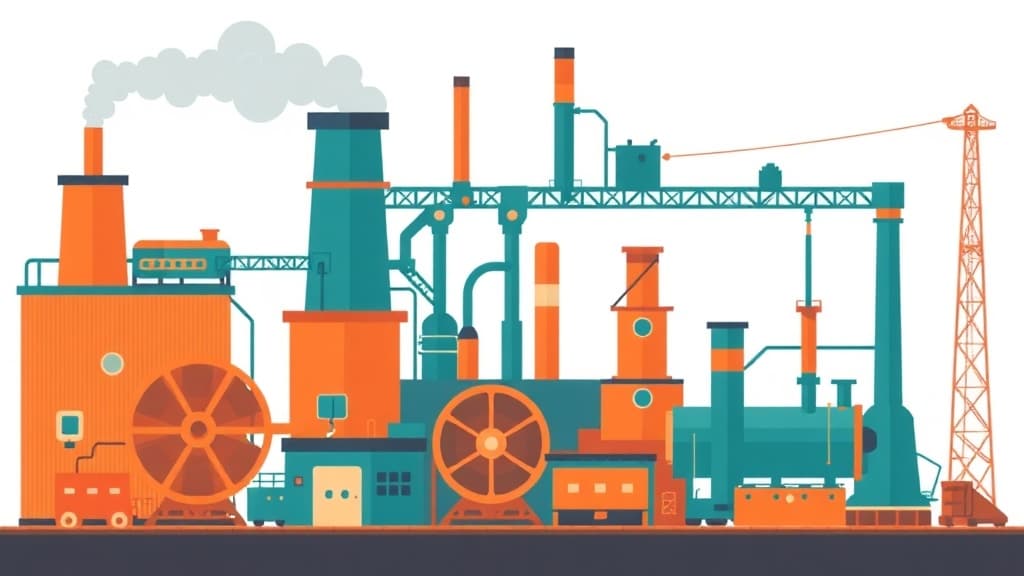
Industrial Revolution brings history and social studies to life through rich, engaging storytelling. It connects past events to the present, presents multiple perspectives fairly, and makes every topic genuinely relevant — turning dates and facts into compelling human stories.
Help me understand this topic for my school revision.
👨💻
I'd love to help! Let's break this down into bite-sized pieces.
First, tell me what year group you are in and if you have any homework questions. I will explain it step-by-step with real-world examples, and we can do a quick quiz at the end to make sure it makes perfect sense!
How to use Industrial Revolution
1
Open Applaa and select this tool from AI Assistants.
2
Ask your history or social studies question — events, people, causes, consequences, or context.
3
Get a clear, engaging explanation with key facts and broader historical context.
What you can do with Industrial Revolution
Steam engines and factories. Here are some of the most popular ways students use Industrial Revolution every day:
Turns dry facts into fascinating, memorable narratives
Explains historical context and diverse perspectives
Perfect for homework, revision, and genuine curiosity about the world
Ask unlimited follow-up questions — the AI never loses patience or gives up on you
Works alongside any textbook, worksheet, or school resource
The Industrial Revolution fundamentally transformed human civilization—steam engines replaced muscle power, factories replaced cottage industries, and Europe's entire social, economic, and environmental landscape shifted within roughly 150 years. Yet this monumental change often feels abstract in history lessons: students learn dates and names without grasping how an 18th-century textile workshop in Lancashire eventually created the modern industrialised world we inhabit. Applaa's Industrial Revolution tool transforms this global upheaval from a timeline of inventions into a lived human experience, showing how steam engines revolutionised production, how factories transformed work and communities, and how innovation in one industry created cascading changes across society. This is essential for KS3 students first encountering this pivotal period, GCSE History learners tackling Industrial Britain, and anyone wanting to understand how modern capitalism and urban society emerged. Rather than memorising which inventor created what machine, you explore the *systems* that changed: how factory work differed from agricultural labour, why cities exploded in population, how environmental pollution became a novel problem, and how wealth distribution shifted as factory owners accumulated capital. Applaa's approach emphasises that the Industrial Revolution wasn't inevitable progress but a deeply consequential transformation with winners and losers—child labour, dangerous conditions, pollution, and social upheaval alongside genuine innovations that enriched human capability. Whether you're writing GCSE History essays on 19th-century Britain, exploring how capitalism emerged, or simply trying to understand the origins of the modern world, this tool provides the depth and nuance that transforms abstract history into comprehensible human reality.
100+
Key inventions and innovations explored with full context
28,000+
GCSE students understanding this pivotal period
100%
Free forever—no hidden fees
How to use Industrial Revolution effectively
Start by understanding pre-industrial Britain: predominantly agricultural, with most people living in villages and small towns, with craft production concentrated in workshops. Then trace how steam power revolutionised this world—Watt's improvements to the steam engine enabled power looms in textile factories, which became so productive that rural handloom weavers couldn't compete, driving migration to cities. Follow this cascade of consequences: cities swelled, housing became scarce and overcrowded, pollution became visible and inescapable, and new social classes emerged (industrial workers and factory owners). Study specific industries: textiles (the initial revolution), iron and steel (enabling railways), and railways themselves (which transformed commerce and migration). For each, understand the technology, the labour conditions, the environmental impact, and the social consequences. Create timelines tracking not just inventions but their human and social effects. Finally, compare Britain's Industrial Revolution with other nations (France, Germany, America) to understand that industrialisation took different paths depending on local resources and social conditions.
Study specific industries in depth (textiles, iron, railways) rather than trying to memorise all inventions—understanding one industry's transformation teaches you the pattern
Compare pre-industrial versus industrial work by reading first-hand accounts from factory workers and rural craftspeople to grasp the enormous life changes
Trace environmental consequences: air pollution in Manchester, water pollution in rivers used for industry, deforestation for fuel—industrialisation created novel environmental crises
Analyse the emergence of new social classes and ideologies: factory owners accumulated wealth rapidly, while workers faced dangerous conditions, leading to early socialism and labour movements
Map population movements from rural to urban areas and understand why cities became overcrowded, disease-ridden, and socially fractured
Consider the role of colonies and empire: British industrialisation partly relied on colonial raw materials (cotton) and colonial markets (for selling manufactured goods)
Common mistakes with Industrial Revolution
The most common error is treating the Industrial Revolution as unambiguous progress, seeing factories and railways as straightforward 'good things' without acknowledging horrific child labour, dangerous conditions, and environmental devastation. Another mistake is treating Britain's industrialisation as inevitable rather than contingent on specific factors: colonies providing raw materials, naval power enabling trade, coal reserves for fuel, and capital available for investment. Students often fail to understand that pre-industrial work, while hard, had different rhythms and social structures than factory labour—this difference is crucial for grasping why the revolution was so disruptive. Many learners also miss the connection between industrialisation and imperialism; Britain partly industrialised by extracting resources from colonies and forcing colonial markets to buy British manufactured goods. Finally, people often underestimate the environmental damage or treat it as a minor side effect rather than a major consequence of industrialisation.
Don't romanticise the Industrial Revolution as pure progress; millions of child labourers, dangerous conditions, and environmental destruction were real costs alongside genuine innovations
Remember that industrialisation wasn't inevitable; specific British circumstances (colonies, coal, capital, naval power) enabled it; other nations faced different pathways
Understand that factory work created entirely new experiences of labour: long hours, no autonomy, repetitive tasks—fundamentally different from pre-industrial work rhythms
Don't separate industrialisation from colonialism; Britain industrialised partly through colonial extraction and by forcing colonies to buy manufactured goods while banning local manufacturing
Avoid treating environmental damage as a minor issue; industrial pollution became visible and health-threatening, creating novel public health crises
Don't assume all working-class people passively accepted industrialisation; resistance was immediate and substantial, leading to Luddite movements and early labour organising
Getting started
Getting Started with Industrial Revolution
Step 1
Download Applaa free and find the Industrial Revolution tool in History & Social Studies
Step 2
Begin with pre-industrial Britain to understand what changed, then trace how steam power revolutionised textile production and created factory systems
Step 3
Study the social and environmental consequences: urbanisation, child labour, pollution, disease, and the emergence of new ideologies responding to these changes
Step 4
Compare Britain's industrialisation with other nations and explore connections between industrialisation and imperialism
1 month free, then 50% off for 3 months — £4.99/mo
While Other Kids Get an AI Head Start, Is Yours Falling Behind?
Give your child the same AI app-building, exam prep and tutoring edge — free for the first month, no credit card needed.
Join 10,000+ students building their first AI-powered apps with Applaa
Frequently asked questions about Industrial Revolution
Will this help with my GCSE History exam on Industrial Britain?
Absolutely. GCSE History covers Industrial Britain extensively, focusing on social, economic, and technological change. This tool provides the depth examiners reward: understanding not just *what* happened but *why* and what the consequences were for different groups.
Why did Britain industrialise first, before other countries?
Multiple factors combined: access to coal for fuel, naval power enabling global trade, colonies providing raw materials and markets, available capital for investment, and a legal system protecting property. The tool explores these conditions in depth, showing industrialisation wasn't inevitable but required specific circumstances.
What happened to handloom weavers and other craftspeople during industrialisation?
Many were driven out of business by factory-produced goods they couldn't compete with, forcing migration to cities or poverty. This real human cost is crucial for understanding industrialisation's impact. Some resisted through movements like Ludditism, which the tool explores as legitimate response to economic displacement, not mindless machine-breaking.
How did industrialisation change people's daily lives?
Dramatically. Factory work meant fixed hours, crowded cities, pollution, disease, and loss of agricultural rhythms. Families moved from villages to urban slums. Children worked in factories instead of learning trades. Environmental pollution became visible and health-threatening. The tool includes first-hand accounts showing how profoundly industrialisation disrupted life.