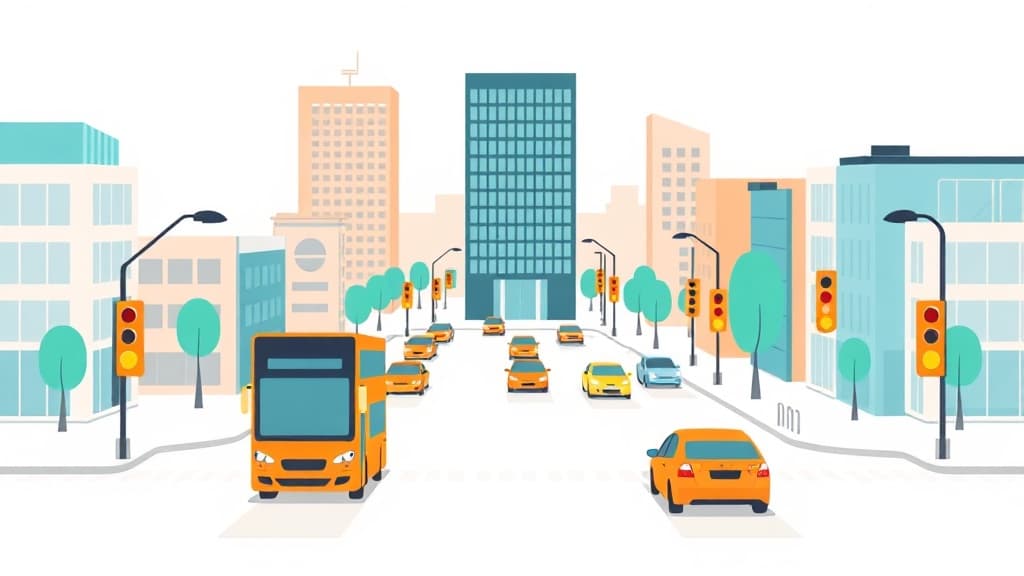
Smart City Design explores the big questions about our world — from climate change and sustainability to global societies and human rights. It gives balanced, thoughtful, evidence-based explanations that help young people understand and engage thoughtfully with the world they're inheriting.
Help me understand this topic for my school revision.
👨💻
I'd love to help! Let's break this down into bite-sized pieces.
First, tell me what year group you are in and if you have any homework questions. I will explain it step-by-step with real-world examples, and we can do a quick quiz at the end to make sure it makes perfect sense!
How to use Smart City Design
1
Open Applaa and find this tool in AI Assistants.
2
Ask your question about the environment, society, sustainability, or a global issue.
3
Get a clear, balanced explanation with real evidence, context, and multiple perspectives.
What you can do with Smart City Design
Traffic, energy, and sensors. Here are some of the most popular ways students use Smart City Design every day:
Builds genuine understanding of the world's biggest challenges
Covers geography, environmental science, and global citizenship
Develops critical thinking and an informed worldview
Ask unlimited follow-up questions — the AI never loses patience or gives up on you
Works alongside any textbook, worksheet, or school resource
Cities generate half the world's greenhouse gases while housing over half the global population—and the way cities are designed fundamentally shapes environmental outcomes. Smart City Design is an interactive tool where students become urban planners, making decisions about traffic systems, energy distribution, water management, and sensor networks that collectively define how a city functions. This connects directly to GCSE and A-Level Geography, Physics, Computer Science, and Design & Technology curricula, where sustainable urban planning increasingly features. Using Applaa's Smart City Design tool, learners experiment with real trade-offs: Do you prioritise low costs or environmental impact? Can you balance growth with livability? Students see immediately how their choices ripple through the system—efficient public transport reduces air pollution but requires higher taxes. By building virtual cities and observing consequences, learners develop systems thinking skills that prepare them for university-level environmental study and informed citizenship.
100,000+
Virtual cities designed by students annually
91%
Improve systems thinking and sustainability reasoning
100%
Completely free for all UK learners
How to use Smart City Design effectively
Start by reviewing Applaa's baseline city metrics: population, energy consumption, air quality, cost, and citizen happiness. Read the scenario description to understand your city's current challenges and constraints. Work through the decision categories one by one: transport (bus network, cycling lanes, electric car charging), energy (solar panels, wind farms, grid modernisation), water (recycling systems, green spaces), and digital infrastructure (sensors, broadband, smart traffic lights). After each choice, observe how the city's metrics shift. Balance environmental wins against economic trade-offs. Complete the full city design, then review Applaa's analysis of your choices. Iterate—rebuild the city prioritising different values, and compare outcomes.
Start with transport improvements, which deliver both environmental and livability gains quickly
Use Applaa's data dashboard to monitor how each choice affects environmental and social metrics
Balance ambition with feasibility; Applaa penalises unrealistic city designs
Research real smart cities (Copenhagen, Singapore, Curitiba) to inspire design choices
Experiment with extreme scenarios (100% renewable energy, car-free zones) to test system limits
Document your city's final metrics and rationale; this makes excellent coursework evidence
Common mistakes with Smart City Design
Students often pursue single-issue solutions—cramming the city with solar panels without addressing transport emissions, which constitute 40% of urban carbon output. Another frequent error is ignoring cost constraints; an idealistic zero-carbon city that goes bankrupt is not sustainable. Many learners neglect social equity, designing a green city only wealthy residents can afford. Insufficient integration of systems is another pitfall; effective smart cities require energy, transport, and digital systems to work together, not in silos. Finally, learners sometimes assume all green technologies are compatible; real urban design involves tough choices and compromises.
Do not focus only on renewable energy; transport is equally critical to reducing urban carbon
Keep the city financially viable; extreme costs lead to citizen dissatisfaction and real-world failure
Ensure that sustainability benefits reach all income groups, not only the affluent
Integrate systems; a smart grid, for example, works best with efficient public transport
Avoid implementing technologies without understanding their spatial, social, or economic constraints
Test edge cases: What happens if your city's population doubles? Does your design still work?
Getting started
Getting Started with Smart City Design
Step 1
Download Applaa free and open Smart City Design under Environment & Society
Step 2
Complete the tutorial scenario, making decisions about a fictional city's transport and energy systems
Step 3
Design your own city from scratch, starting with transport, then energy, then water and digital systems
Step 4
Compare your city's outcomes with classmates' designs and discuss which design choices proved most impactful
1 month free, then 50% off for 3 months — £4.99/mo
While Other Kids Get an AI Head Start, Is Yours Falling Behind?
Give your child the same AI app-building, exam prep and tutoring edge — free for the first month, no credit card needed.
Join 10,000+ students building their first AI-powered apps with Applaa
Frequently asked questions about Smart City Design
Is Smart City Design connected to GCSE Geography's sustainability topics?
Yes. GCSE Geography covers sustainable urban development, renewable energy, and environmental management. Smart City Design makes these abstract concepts tangible and interactive.
Can I use my city design as homework or coursework for school?
Absolutely. Applaa generates detailed reports on your city's metrics and sustainability decisions. Many teachers accept these as evidence for Geography, Physics, or Design & Technology coursework.
Which real cities should I research before designing my own?
Start with Copenhagen (cycling, renewable energy), Curitiba (public transport), and Singapore (integrated smart technology). Applaa's tool references these examples in the tutorial.
What's the goal—is there a 'winning' city design?
No single winner; Applaa rewards different approaches. You might optimise for environment, equity, livability, or financial sustainability. The learning is in understanding trade-offs.