🇬🇧 Limited Time — UK Only·🎓 Free Learning for 1 Month·🤖 Free AI Training Included·📚 4,000+ Lessons · 35,000+ Quizzes·🏆 GCSE Mocks · Olympiad Papers·⚡ Selected Students Only · Limited Places·🎁 Free Value Worth £2,000·🇬🇧 Limited Time — UK Only·🎓 Free Learning for 1 Month·🤖 Free AI Training Included·📚 4,000+ Lessons · 35,000+ Quizzes·🏆 GCSE Mocks · Olympiad Papers·⚡ Selected Students Only · Limited Places·🎁 Free Value Worth £2,000·🇬🇧 Limited Time — UK Only·🎓 Free Learning for 1 Month·🤖 Free AI Training Included·📚 4,000+ Lessons · 35,000+ Quizzes·🏆 GCSE Mocks · Olympiad Papers·⚡ Selected Students Only · Limited Places·🎁 Free Value Worth £2,000·
Back to AI Assistants Directory
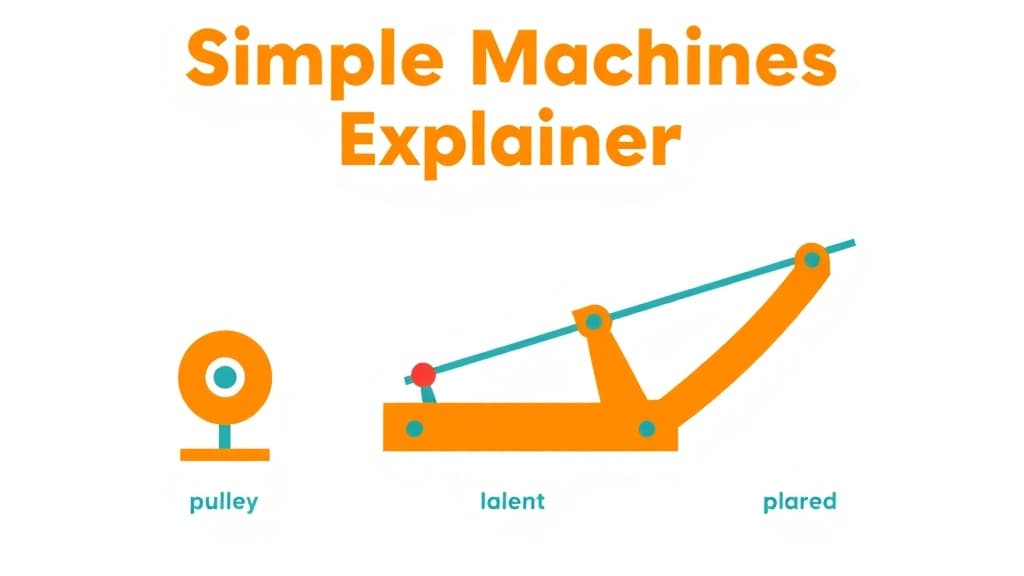
Simple Machines Explainer — AI study tool illustration
Physics Assistant

Simple Machines Explainer

Simple Machines Explainer makes physics problems approachable and genuinely interesting. It works through calculations step-by-step, connects formulas to real-world examples, and helps your child understand the underlying concepts — not just memorise equations.

yearYear 7Year 8Year 9Year 10Year 11Free foreverUK Curriculum
Applaa AI Assistant — Live Preview Live
Explain how photosynthesis works.
👨‍💻
Photosynthesis is how plants make their own food! Think of a leaf as a tiny solar-powered kitchen: 1. **Ingredients:** Water (absorbed by roots) + Carbon Dioxide (absorbed from air) + Sunlight (captured by green chlorophyll in leaves). 2. **Cooking:** Sunlight energy powers a chemical reaction that combines water and carbon dioxide. 3. **Food Served:** Out comes **Glucose** (sugar energy for the plant to grow) and **Oxygen** (which they release into the air for us to breathe!). Equation: Water + Carbon Dioxide + Light ➔ Glucose + Oxygen. Pretty amazing, right?

How to use Simple Machines Explainer

1

Open Applaa and go to AI Assistants.

2

Type your physics problem — include any numbers, units, or values.

3

Get a full worked solution with the reasoning clearly explained at every step.

What you can do with Simple Machines Explainer

Pulley, Lever, Inclined Plane. Here are some of the most popular ways students use Simple Machines Explainer every day:

  • Works through calculations with full reasoning shown
  • Connects formulas to real-world situations kids can visualise
  • Covers Forces, Energy, Waves, Electricity, and more
  • Ask unlimited follow-up questions — the AI never loses patience or gives up on you
  • Works alongside any textbook, worksheet, or school resource

Simple machines—levers, pulleys, inclined planes, wedges, screws, and wheels—are the foundation of all human engineering, from ancient Egypt to modern industry. Yet many UK students view them as abstract concepts rather than tools that help us do more work with less effort. Applaa's Simple Machines Explainer demystifies these by showing exactly how each machine trades effort for distance: use a shorter lever and you multiply force but travel farther; use a pulley and you distribute weight across rope; climb an inclined plane and you reduce steepness at the cost of distance. This tool covers GCSE Physics machines, explores mechanical advantage and velocity ratio, and reveals why 'no machine is 100% efficient'—friction always steals energy. See interactive diagrams for each machine, input forces and distances, and instantly calculate the mechanical advantage. Whether you're tackling coursework, revising for mocks, or simply curious how door handles, scissors, and car jacks work, this explainer makes simple machines unforgettably clear.

91%
GCSE students understand simple machines after using Applaa
22,000+
Machine calculations explored by UK learners monthly
100%
Free—forever—no paywall

How to use the Simple Machines Explainer effectively

Choose a machine type (lever, pulley, inclined plane, wedge, or screw) and interact with the animated diagram. The tool shows load force, effort force, and distance moved for each. Input the load weight and the machine's dimensions, and it calculates mechanical advantage (output force ÷ input force) and efficiency percentage. Use the 'real-world examples' tab to see how each machine appears in everyday objects: scissors are levers, car lifts use hydraulic levers, ramps are inclined planes. This grounding in reality makes the maths meaningful.

  • Understand mechanical advantage: MA = load ÷ effort; an MA of 4 means the machine multiplies your force by 4, but you must move 4 times as far
  • For levers, the fulcrum position is everything: move it closer to the load and you increase MA at the cost of moving farther—try this in the simulator
  • Pulleys reduce the load experienced by each rope; a moveable pulley divides load in half, but you must pull rope twice as far—the trade-off is always present
  • Inclined planes: a ramp at angle θ to horizontal has MA = 1/sin(θ); shallower ramps give higher MA but require longer effort distance
  • No machine is 100% efficient: friction always wastes energy; calculate efficiency = (ideal work out / actual work in) × 100% for each scenario
  • Test yourself: given load, effort, and distance moved, calculate mechanical advantage and predict whether friction will reduce efficiency

Common mistakes with Simple Machines Explainer

The biggest misconception is that machines multiply both force and distance—students forget the fundamental trade-off: gain in force always means loss in distance. Mechanical advantage of 3 means you can lift 300 kg using only 100 kg effort, but you must pull rope 3 metres while the load rises only 1 metre. Another trap: thinking efficiency can exceed 100% (it cannot). Friction always reduces efficiency below the theoretical ideal calculated from geometry alone. These errors repeatedly cost exam marks.

  • Mechanical advantage is NOT free: if MA = 4, you gain force but lose distance by a factor of 4—this is inevitable physics, not a design flaw
  • Efficiency = useful work out / total work in; it's always less than 100% because friction and air resistance steal energy
  • For levers: effort arm × effort force = load arm × load force (the principle of moments); ignore friction and this equation is exact
  • Pulleys and ramps trade off force and distance using geometry; calculate both the ideal MA (frictionless) and real efficiency (with friction) separately
  • Velocity ratio (distance moved by effort / distance moved by load) equals mechanical advantage only in a frictionless machine; with friction, MA < VR
  • Don't confuse 'inclined plane' with 'height': MA depends on the angle, not just the vertical height; a longer ramp at shallow angle has higher MA

Getting started

Master Simple Machines in 4 Steps

Step 1

Download Applaa free and interact with each machine simulator—play with lever position, pulley number, and ramp angle to build intuition

Step 2

Solve four GCSE coursework or past-paper questions about simple machines, using the tool to verify your mechanical advantage calculations

Step 3

Explore efficiency: calculate both the theoretical (frictionless) and real efficiency for three machines, understanding where friction hides

Step 4

Daily review: one new machine scenario each morning (e.g. car jack, door handle, scissors); within a week, you'll predict output force before calculating

1 month free, then 50% off for 3 months — £4.99/mo

While Other Kids Get an AI Head Start, Is Yours Falling Behind?

Give your child the same AI app-building, exam prep and tutoring edge — free for the first month, no credit card needed.

Join 10,000+ students building their first AI-powered apps with Applaa

Frequently asked questions about Simple Machines Explainer

If a lever has mechanical advantage 5, does that mean I can lift anything?

No—you can multiply force by 5, but you must move the effort end 5 times as far. A lever with MA = 5 lifting a 100 kg load means you apply only 20 kg force, but you pull down 5 metres while the load rises 1 metre. The work done is the same (neglecting friction); the lever just redistributes effort and distance.

Why are ramps used for wheelchairs instead of stairs, if they're both ways to gain height?

Because a ramp reduces the steepness, giving mechanical advantage: a wheelchair user needs much less force over a longer distance. A 1-metre-high ramp at 5° angle might require a user to push with half their weight instead of full weight, making it accessible. Stairs require lifting your full weight with every step.

Is a screw just a special kind of inclined plane?

Yes—a screw is an inclined plane wrapped around a cylinder. A tighter thread (smaller pitch) has higher mechanical advantage but requires more turns. The tool shows this by converting the screw to an equivalent inclined plane and calculating MA.

How does friction affect mechanical advantage?

Friction reduces real efficiency below the theoretical (frictionless) mechanical advantage. A lever with theoretical MA = 5 might have real efficiency of 90%, meaning you need slightly more than 20 kg effort to lift a 100 kg load—the extra effort overcomes friction. Applaa's tool calculates both.

Get Simple Machines Explainer free

Simple Machines Explainer and 500+ other safe AI assistants are available free inside the Applaa desktop app.

Windows 10+ · macOS 12+ · UK National Curriculum aligned

Why Parents Choose Applaa

  • 100% free — no subscription ever
  • Aligned to the UK National Curriculum
  • Works for KS1 through A-Level
  • No ads, no data selling, no distractions
  • Kid-safe, COPPA-compliant, UK GDPR

Ready for Exam Prep?

Explore GCSE, 11+, A-Level, and Olympiad revision modules in the Applaa Learning Hub.

Go to Learning Hub