Is mind mapping useful for exam revision?
Absolutely. Create mind maps for each major topic in your subject, then use them as revision reference sheets. The visual nature makes concepts stick better than lists or notes.
Mind Map Planner is a supportive personal growth guide that helps children and teenagers build emotional intelligence, resilience, and confidence. It provides thoughtful, age-appropriate guidance on understanding themselves, managing challenges, and navigating the world with greater clarity and self-belief.
Open Applaa and go to AI Assistants.
Share what you're working on, finding difficult, or want to improve about yourself.
Get practical, compassionate advice and simple exercises you can apply right away.
Brainstorm ideas visually. Here are some of the most popular ways students use Mind Map Planner every day:
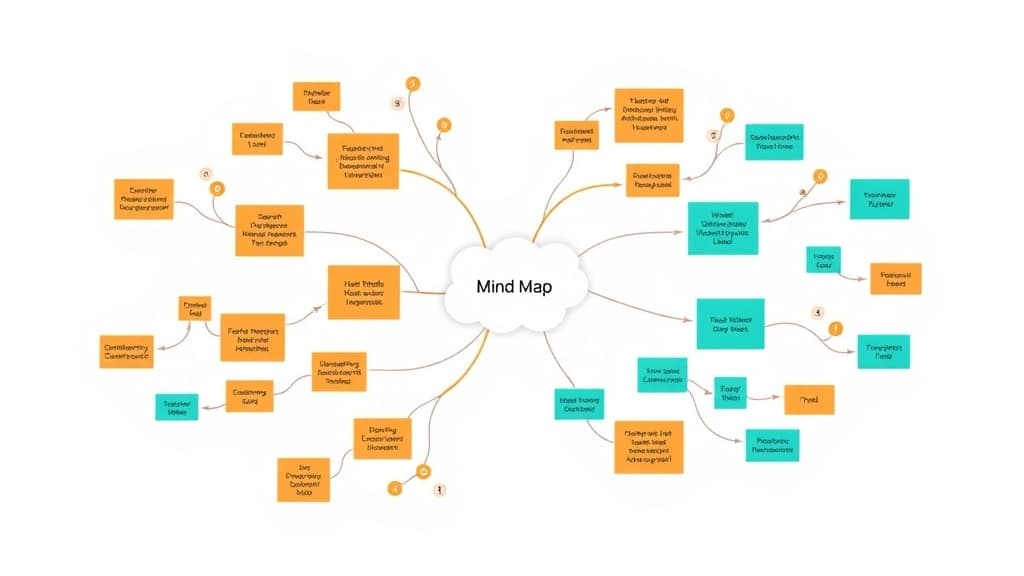
Mind mapping is a powerful visual brainstorming technique that UK students rarely learn formally, despite its transformative effect on organising complex ideas and boosting creative thinking. The Mind Map Planner turns abstract brainstorming into a structured visual process, helping you capture ideas, spot connections, and plan projects in a way that matches how your brain actually works. Instead of staring at a blank page with essay anxiety or drowning in revision notes, mind mapping lets you externalise your thinking—writing each idea as a node, then visually clustering related concepts. This is invaluable for essay planning, revising for GCSEs and A-Levels, project management, and creative writing. Applaa's Mind Map Planner provides interactive templates, example mind maps, and step-by-step guidance so you can create effective visual plans from scratch. Whether you're stuck on a homework assignment, planning a presentation, or tackling a complex topic like photosynthesis or English Literature analysis, mind mapping transforms how you engage with material. It's completely free and built directly into Applaa, making visual planning accessible to every UK student.
Start by placing your main topic or question in the centre of your mind map. Then, without judging or editing, brainstorm main themes or subtopics and branch them out from the centre. Each branch should have 3-5 sub-ideas, creating a web of interconnected thinking. Use colour, symbols, and brief keywords (not sentences) to make your map visual and memorable. The power of mind mapping isn't just organisation; it's discovery. As you build your map, unexpected connections emerge, gaps become obvious, and your understanding deepens. Once you've created a draft mind map, step back and look for patterns. This is when you decide what's important for your essay, revision, or project. Refine your map by eliminating low-priority branches and deepening high-value areas.
One mistake is including too much text; mind maps should be visual and scannable, not dense paragraphs. Another is failing to think broadly at the start—if you only brainstorm 'safe' or obvious ideas, you miss the creative thinking that mind mapping is built for. Some students also map everything at once instead of creating a draft, then refining. The refinement step is crucial; your first map is messy and incomplete, and that's exactly right. Finally, avoid creating a mind map and then never using it; the real power is in using your map to guide your writing, revision, or presentation.
Getting started
Download Applaa free and open the Mind Map Planner from your Study Tools
Choose a topic you're currently studying (an essay question, revision chapter, or project brief)
Create a first-draft mind map in 10 minutes; aim for quantity over quality
Step back and refine your map, then use it to guide your writing, revision, or presentation
Give your child the same AI app-building, exam prep and tutoring edge — free for the first month, no credit card needed.
Join 10,000+ students building their first AI-powered apps with Applaa
Absolutely. Create mind maps for each major topic in your subject, then use them as revision reference sheets. The visual nature makes concepts stick better than lists or notes.
Yes—this is one of the most valuable uses. Map your essay question, brainstorm arguments and evidence, then structure your essay from the map. It saves time and improves essay quality.
Mind mapping isn't about artistic skill; it's about organisation and clarity. Use simple shapes, stick figures, or just text with branches. Function matters far more than aesthetics.
Yes. Use mind maps to link formulae to real-world applications, to cluster related concepts (like types of bonding in Chemistry), or to plan experimental investigation projects.
Mind Map Planner and 500+ other safe AI assistants are available free inside the Applaa desktop app.
Explore GCSE, 11+, A-Level, and Olympiad revision modules in the Applaa Learning Hub.
Go to Learning Hub