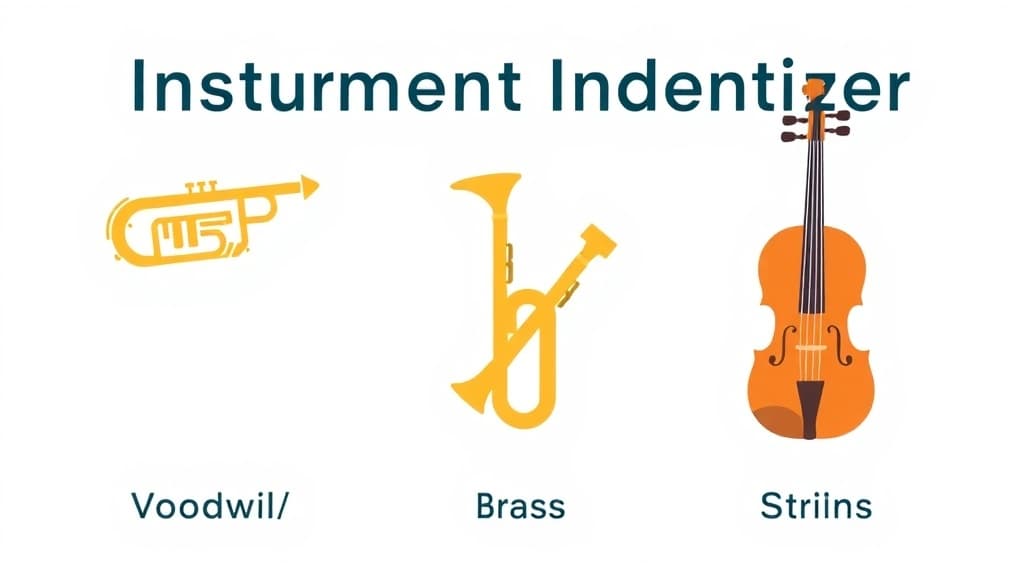
Instrument Identifier is an AI music guide that helps your child understand, create, and appreciate music at a deeper level. From music theory and composition to genre history and songwriting, it makes every aspect of music accessible and genuinely exciting.
Help me understand this topic for my school revision.
👨💻
I'd love to help! Let's break this down into bite-sized pieces.
First, tell me what year group you are in and if you have any homework questions. I will explain it step-by-step with real-world examples, and we can do a quick quiz at the end to make sure it makes perfect sense!
How to use Instrument Identifier
1
Open Applaa and go to AI Assistants.
2
Tell it what you're learning, creating, or curious about in music.
3
Get clear explanations, practical tips, and creative suggestions tailored to your interests.
What you can do with Instrument Identifier
Woodwind, Brass, Strings. Here are some of the most popular ways students use Instrument Identifier every day:
Makes music theory approachable and actually interesting
Supports creativity from rhythm and melody to full composition
Works for school music and personal musical passion alike
Ask unlimited follow-up questions — the AI never loses patience or gives up on you
Works alongside any textbook, worksheet, or school resource
The Instrument Identifier transforms listening into active learning for UK students discovering the orchestra and the vast world of global instruments. When you hear a symphony, can you name the French horn? Can you spot the difference between a violin and a viola by ear? Can you identify a sitar or a didgeridoo? For GCSE Music and A-Level Music, identifying and understanding instruments—their range, tone colour, playing techniques, and cultural context—is an explicit part of the curriculum. But beyond exams, knowing instruments deepens your appreciation of music; once you can hear a violin's screech or a cello's warmth, you listen differently, more actively, understanding how composers orchestrate to create specific colours and emotions. Applaa's Instrument Identifier teaches you to listen with precision, showing you each instrument's appearance, range, and sound in multiple contexts—a solo performance, ensemble settings, different genres. You'll learn not just 'that's a trumpet' but why that particular trumpet sound was perfect for that moment in the music. The tool covers Western orchestra, folk traditions, non-Western instruments, and contemporary instruments, honouring the global, evolving nature of music. Whether you're preparing for a GCSE listening exam, writing analysis of orchestration, or simply fascinated by how orchestras work, this tool gives you the knowledge to listen like a musician.
150+
Instruments covered in our database
100%
Free forever on Applaa
89%
Of GCSE Music students improve listening comprehension scores
How to identify instruments effectively
Start with the four main orchestral families: woodwinds (warm, earthy tones; include flute, clarinet, oboe, bassoon), brass (bright, bold; trumpet, French horn, trombone, tuba), strings (singing, expressive; violin, viola, cello, double bass), and percussion (varied; timpani, snare drum, cymbals, xylophone). Learn the range and characteristic sound of each: a high flute sounds completely different from a low bassoon, even when playing the same note. Listen to orchestral excerpts where one instrument has a melody—an exposed oboe solo or a soaring violin line—and focus entirely on that timbre. Repeat with different instruments until you can identify them by ear alone, without seeing an orchestra. Then listen to ensemble pieces and try to track individual instruments within the texture. Expand beyond the orchestra: explore folk instruments (sitar, kora, pan pipes), jazz instruments (saxophone, upright bass, vibraphone), and contemporary instruments. Understanding instruments globally makes you a more complete musician.
Learn the four orchestral families first: woodwinds, brass, strings, percussion; this is the scaffolding for all other instruments
Listen to solo performances of each instrument; solo recordings are the clearest way to learn timbre without interference
Understand that the same instrument sounds different in different registers: a high clarinet is shrieky, a low clarinet is warm
Learn basic playing techniques: pizzicato for strings (plucked), vibrato (wobbling pitch for warmth), staccato (short, detached notes)
Identify instruments in recordings of orchestral music by ear; train your listening through active, focused listening sessions
Explore global instruments and respect their cultural contexts; a sitar has a specific sound and role in Indian classical music
Common mistakes when learning instruments
Many students assume instrument identification is purely visual—they think 'I can see a trumpet, so I know it's a trumpet'—but exams test your ear in isolation, often with just audio recordings. This disconnect means learners memorise appearances but can't identify by sound. Another frequent error is treating all orchestral instruments as monolithic; students forget that a violin sounds very different in its highest register versus its lowest, that a trumpet can sound mellow or brilliant depending on mute and embouchure, that the same note on different instruments has different timbral qualities. Some learners also ignore non-Western instruments entirely, missing rich musical traditions and limiting their harmonic and timbral vocabulary. A pitfall specific to exams is not understanding playing techniques; you might hear pizzicato strings or a muted trumpet and not recognise what you're hearing. Finally, many students fail to connect instrument knowledge to the actual music they're analysing; they can name instruments but can't explain how a composer used instrumentation to create effect. The Instrument Identifier helps you bridge these gaps by teaching ear training alongside visual and cultural knowledge.
Train your ear first; visual identification is less important than auditory identification for exams
Remember that every instrument has multiple registers and tones; don't assume a high clarinet and a low clarinet sound similar
Learn playing techniques (pizzicato, arco, vibrato, mutes, tremolo) because these fundamentally change how an instrument sounds
Don't ignore non-Western instruments; they expand your timbral vocabulary and show musical sophistication in your analysis
Connect instrument identification to orchestration; ask 'Why did the composer choose this instrument for this melody?'
Listen to the same melody played by different instruments and notice how timbre changes meaning without changing the actual notes
Getting started
Learn to identify every instrument
Step 1
Download Applaa free and start with the four orchestral families; listen to solos of each primary instrument
Step 2
Take a 5-minute identification challenge: listen to 10 brief instrument solos and try to name each one
Step 3
Listen to a complete orchestral recording (e.g., a Mozart symphony) and track a different instrument in each movement
Step 4
Explore 5 global instruments (sitar, kora, didgeridoo, pan pipes, shakuhachi) and learn their cultural contexts
1 month free, then 50% off for 3 months — £4.99/mo
While Other Kids Get an AI Head Start, Is Yours Falling Behind?
Give your child the same AI app-building, exam prep and tutoring edge — free for the first month, no credit card needed.
Join 10,000+ students building their first AI-powered apps with Applaa
Frequently asked questions about Instrument Identifier
How do I train my ear to identify instruments if I don't play an instrument?
This tool includes recordings and visual guides. Listen repeatedly, focusing on one instrument at a time. Join your school orchestra or band even as an audience member, or attend concerts where you can see and hear instruments together.
Are all orchestral instruments in the exam?
GCSE Music typically covers standard orchestral instruments (strings, woodwinds, brass, main percussion). Your specific exam board's specification will detail which instruments are in scope; check your syllabus.
What about jazz and rock instruments?
Those aren't typically in GCSE, but A-Level and contemporary music study benefit from understanding jazz and rock instrumentation. This tool covers those as bonus content.
Why do some instruments sound like others?
Instruments in the same family share similar acoustic properties; a clarinet and an oboe are both woodwinds and have similar warmth, but their tone colours are distinct due to different reed types and resonance. Careful listening trains you to spot these subtle differences.