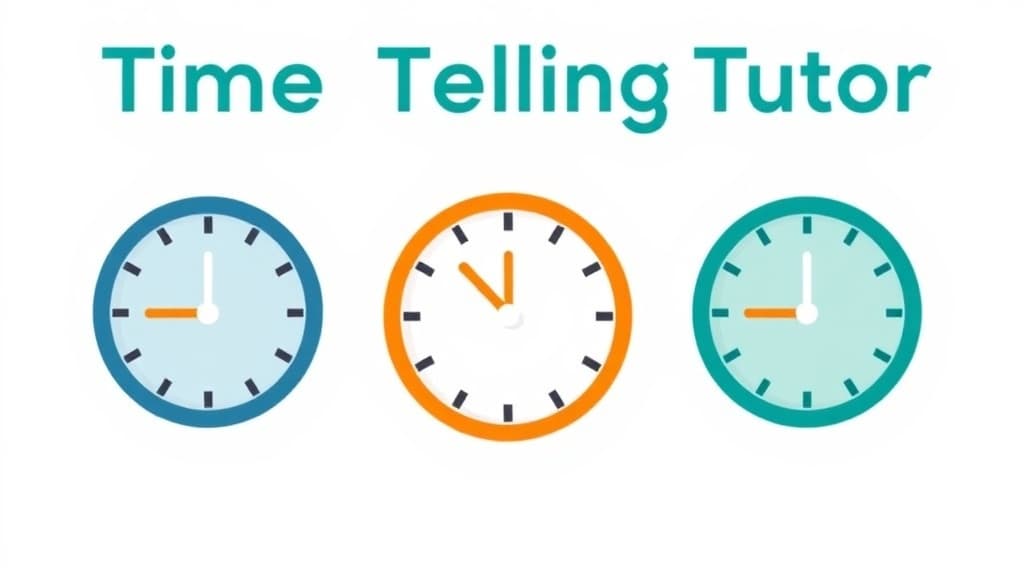
Time Telling Tutor is your child's personal maths tutor available 24/7 inside the free Applaa app. It explains every concept step-by-step, adapts to their level, and never moves on until they actually understand — from KS1 basics to A-Level calculus.
Of course! Let's solve it step-by-step:
1. **Subtract 7 from both sides** to get the terms with x by themselves:
3x = 22 - 7
3x = 15
2. **Divide both sides by 3** to solve for x:
x = 15 ÷ 3
x = 5
To check our answer, let's plug 5 back in: 3(5) + 7 = 15 + 7 = 22. It works! Ready to try a similar one?
How to use Time Telling Tutor
1
Open Applaa and go to AI Assistants.
2
Find "Time Telling Tutor" and type the problem in plain English — no special symbols needed.
3
Get a full worked solution with explanations, then ask follow-up questions until it completely clicks.
What you can do with Time Telling Tutor
Learn to read clocks. Here are some of the most popular ways students use Time Telling Tutor every day:
Breaks every problem into clear, logical steps
Covers KS1 through A-Level — grows with your child
Available any time, 100% free, no limits
Ask unlimited follow-up questions — the AI never loses patience or gives up on you
Works alongside any textbook, worksheet, or school resource
Telling the time seems like it should be simple, yet many primary children (ages 5–8) find it surprisingly difficult — understanding that the small hand shows hours, the big hand shows minutes, that 12 o'clock is both 'twelve' and 'zero minutes,' and that the same time can be written multiple ways (3:00, 3 o'clock, 15:00). Applaa's Time Telling Tutor breaks down this complex skill into manageable steps, using interactive clocks where children manipulate the hands themselves and see time change dynamically. We start with 'o'clock' times (1:00, 2:00) which are easiest, then progress to half-past and quarter-past, then five-minute intervals, and eventually to precise minute-reading. By Year 2 (age 6–7), UK children should tell time to the quarter hour; by Year 3 (age 8), they should read analogue clocks accurately to the minute. Applaa makes this journey visual, interactive, and fun, tracking which time concepts your child finds tricky and providing targeted practice. With daily, playful practice, time-telling becomes automatic — a skill children use confidently throughout school and life.
8,300+
UK children building time-telling confidence
91%
tell time to the quarter-hour by Year 2
100%
free with interactive analogue and digital clocks
How to use Time Telling Tutor effectively
Start with hour times (o'clock): the hour hand points to the number, the minute hand points to 12. Applaa shows a large, clear clock and lets your child drag the hands to show, say, 3 o'clock. Once this is fluent, introduce half-past: the hour hand is halfway between two numbers, the minute hand points to 6. Play 'Show me half-past 4' repeatedly until confident. Progress to quarter-past and quarter-to (minute hand points to 3 or 9), understanding that quarter-past 4 is 4:15 and quarter-to 5 is 4:45. Once this is solid (weeks of practice), introduce five-minute intervals: reading the minute hand in 5s (5, 10, 15, 20, 25, 30, 35, 40, 45, 50, 55). Finally, introduce individual minutes. Use real clocks and real time at home: 'Look at the big clock, what time is it?' Build connections to daily routines: 'We eat lunch at 12:30, that's half-past 12. Look at the clock — that's what it looks like.'
Start with 'o'clock' times (1:00, 2:00, etc.) — these are easiest and build confidence
Teach the roles of both hands explicitly: small hand = hours, big hand = minutes
Use 'half-past' and 'quarter-past' language alongside numerals (3:30 is 'half-past 3')
Skip-count by 5s around the clock: use the minute hand to practise 5, 10, 15, 20, etc.
Use real clocks and daily routines: 'We have lunch at 12:30 — look at the clock'
Play digital and analogue together: show 3:15 in numbers, then on the clock face; connect both
Common mistakes children make telling time
Many children confuse the two hands, thinking the hour hand is the 'minute hand' because it's moving (even slightly) or focusing only on the minute hand and ignoring the hour hand entirely. Some children can read 'o'clock' times but haven't grasped that when the minute hand is pointing to 6, the hour hand is halfway to the next hour (so at 3:30, the hour hand is between 3 and 4). Others memorise specific times ('When the hands are pointing there, it's 3 o'clock') without understanding the underlying logic, so unfamiliar times confuse them. A critical error is not understanding 'half-past' and 'quarter-past' as concepts — they recite '3:30' but can't explain why the hour hand is between 3 and 4. Some children skip five-minute intervals and jump straight to minutes, struggling because they haven't automated the 5, 10, 15, 20 sequence. Finally, many children haven't connected analogue clocks (traditional clock faces) to digital time (3:45), so they can read one but not the other.
Don't skip the hour hand — many children focus only on the minute hand and miss critical information
Teach explicitly that at half-past, the hour hand is halfway to the next number — not pointing exactly at a number
Teach skip-counting by 5s explicitly; don't assume children know this essential skill for reading minutes
Connect analogue and digital representations: show 3:30 both on a clock face and in numbers
Don't let children memorise specific times without understanding why — build logic, not rote memory
Avoid rushing to precise minute-reading before quarter-times are solid — don't skip developmental stages
Getting started
Getting started with Time Telling Tutor
Step 1
Download Applaa free and open Time Telling Tutor for your child's year group
Step 2
Start with 'o'clock' times: use Applaa's interactive clock to show 1:00, 2:00, 3:00 repeatedly
Step 3
Play daily for 5–10 minutes, building to half-past and quarter-past before introducing minutes
Step 4
Use real clocks at home: point out times during daily routines ('Look, it's half-past 8, time for school')
1 month free, then 50% off for 3 months — £4.99/mo
While Other Kids Get an AI Head Start, Is Yours Falling Behind?
Give your child the same AI app-building, exam prep and tutoring edge — free for the first month, no credit card needed.
Join 10,000+ students building their first AI-powered apps with Applaa
Frequently asked questions about Time Telling Tutor
At what age should my child learn to tell the time?
UK schools typically introduce 'o'clock' times in Reception/Year 1 (age 5–6), with half-past and quarter-past in Year 2 (age 6–7). Reading to the minute usually comes in Year 3 (age 8). Applaa adapts to your child's pace, so you can start whenever they're ready to learn time concepts.
Why do children find the hour hand so confusing?
The hour hand is subtle — it moves slowly and gradually throughout the hour, so children don't notice it moving like they do the minute hand. Pointing it out explicitly ('Look, at half-past 3, the little hand is halfway between 3 and 4') helps. Some children need this pointed out dozens of times before it clicks.
Should I teach analogue or digital clocks first?
Analogue (traditional clock faces) first — it shows the logical structure of time visually (the hour hand's position, the minute hand's rotation). Digital time (3:45) is more abstract. Once analogue makes sense, digital becomes the shorthand notation for the same concept. Applaa teaches analogue first, then connects to digital.
My child knows o'clock times but struggles with half-past. What's happening?
Half-past requires understanding that the hour hand moves gradually, not jumping from number to number. At half-past 3, the hour hand is halfway between 3 and 4 — many children find this counterintuitive. Use a real clock, move the hands slowly, and point it out repeatedly: 'See? At 3:30, the little hand is right in the middle between 3 and 4.' This concept often takes weeks of repeated exposure to stick.