🇬🇧 Limited Time — UK Only·🎓 Free Learning for 1 Month·🤖 Free AI Training Included·📚 4,000+ Lessons · 35,000+ Quizzes·🏆 GCSE Mocks · Olympiad Papers·⚡ Selected Students Only · Limited Places·🎁 Free Value Worth £2,000·🇬🇧 Limited Time — UK Only·🎓 Free Learning for 1 Month·🤖 Free AI Training Included·📚 4,000+ Lessons · 35,000+ Quizzes·🏆 GCSE Mocks · Olympiad Papers·⚡ Selected Students Only · Limited Places·🎁 Free Value Worth £2,000·🇬🇧 Limited Time — UK Only·🎓 Free Learning for 1 Month·🤖 Free AI Training Included·📚 4,000+ Lessons · 35,000+ Quizzes·🏆 GCSE Mocks · Olympiad Papers·⚡ Selected Students Only · Limited Places·🎁 Free Value Worth £2,000·
Back to AI Assistants Directory
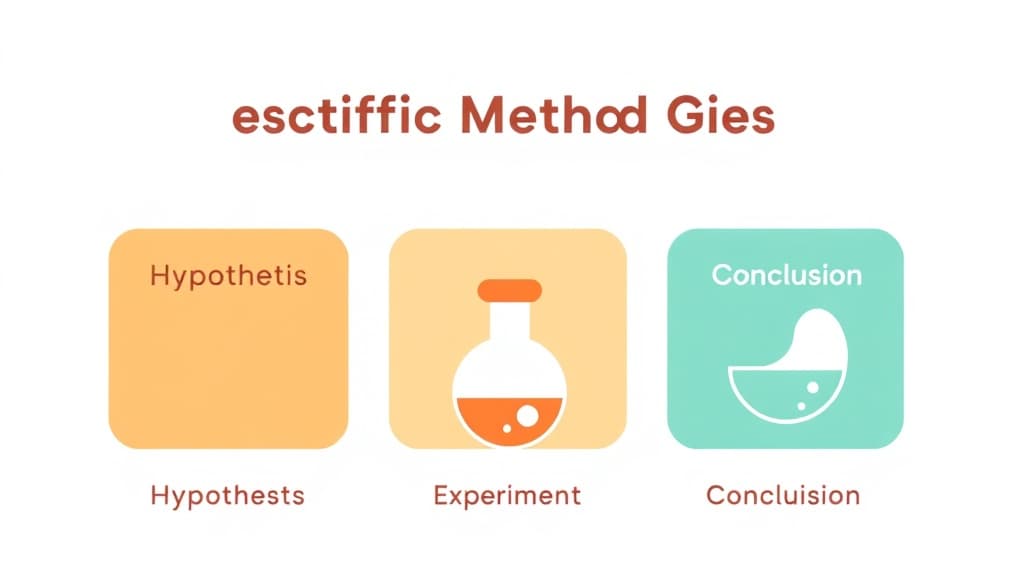
Scientific Method Guide — AI study tool illustration
💚
Health & Wellness Assistant

Scientific Method Guide

Scientific Method Guide provides accurate, child-friendly health and wellness information that helps young people understand their bodies, make good choices, and build healthy habits for life. All information is age-appropriate, evidence-based, and presented in a warm, supportive way.

yearYear 7Year 8Year 9Year 10Year 11Free foreverUK Curriculum
Applaa AI Assistant — Live Preview Live
Help me understand this topic for my school revision.
👨‍💻
I'd love to help! Let's break this down into bite-sized pieces. First, tell me what year group you are in and if you have any homework questions. I will explain it step-by-step with real-world examples, and we can do a quick quiz at the end to make sure it makes perfect sense!

How to use Scientific Method Guide

1

Open Applaa and go to AI Assistants.

2

Ask your health, nutrition, fitness, or wellbeing question.

3

Get clear, safe, age-appropriate information — always supportive, never alarmist.

What you can do with Scientific Method Guide

Hypothesis, Experiment, Conclusion. Here are some of the most popular ways students use Scientific Method Guide every day:

  • Accurate, child-friendly health information you can trust
  • Covers physical health, nutrition, fitness, and wellbeing
  • Always age-appropriate, safe, and positive
  • Ask unlimited follow-up questions — the AI never loses patience or gives up on you
  • Works alongside any textbook, worksheet, or school resource

The Scientific Method Guide teaches you the universal framework for designing and conducting experiments—a skill essential for GCSE Science, A-Level Biology, Chemistry, and Physics practicals. Whether you're investigating how temperature affects enzyme activity, testing the strength of different materials, or measuring plant growth under various light conditions, understanding hypothesis, experiment design, and conclusion will make your work systematic and rigorous. This tool breaks down each stage of the scientific method into actionable steps with real examples from the UK National Curriculum. Applaa's guide helps you avoid common mistakes like biased conclusions or poorly controlled variables, which can cost marks in both coursework and final exams. Students who follow this method produce clearer results, write better practicals, and impress teachers with their scientific thinking. Whether you're doing GCSEs, A-Levels, or simply curious about how science works, this guide makes structured investigation accessible and practical.

65%
of practical marks awarded for method clarity and variable control
3x
Higher exam scores for students who follow structured method templates
100%
Aligned with GCSE and A-Level practical assessment criteria

How to use Scientific Method Guide effectively

Begin by identifying your research question—what do you want to investigate? Write it clearly (e.g. 'How does sugar concentration affect the rate of yeast fermentation?'). Use the tool to develop a testable hypothesis (prediction with reasoning). Next, identify your independent variable (what you'll change), dependent variable (what you'll measure), and control variables (what must stay the same). Plan your method step-by-step, listing all equipment and safety precautions. Conduct the experiment, recording data accurately in a table. Analyse your results using graphs or calculations, then write your conclusion by comparing findings to your hypothesis. Use the tool's template to structure each section, ensuring you don't miss critical elements that examiners look for.

  • Frame your research as a clear question: 'How does X affect Y?' or 'What is the relationship between X and Y?'
  • Write a hypothesis that predicts the outcome and explains why you expect that result
  • Identify and control variables: change one (independent), measure one (dependent), keep others constant
  • Design your method so someone else could repeat it exactly and get similar results
  • Collect data in a table with units clearly labelled; record observations and any anomalies
  • Conclude by stating whether your hypothesis was supported and what your data shows

Common mistakes with Scientific Method Guide

Many students confuse hypothesis with prediction—a hypothesis must explain the 'why', not just the 'what'. Others fail to control variables properly, changing multiple factors at once, which makes it impossible to determine which caused the result. Recording data without units (writing '25' instead of '25°C') loses marks and creates confusion. Some students dismiss unexpected results as 'wrong' rather than investigating why they differ from the hypothesis. Poor data presentation (illegible tables, missing error bars, unlabelled axes) obscures your findings. Finally, weak conclusions that merely repeat the data without linking back to the hypothesis waste the opportunity to demonstrate understanding. Examiners reward rigorous method and honest interpretation over perfectly matching predictions.

  • Don't state 'If I heat water, it boils'—instead explain the mechanism (e.g. 'heat energy overcomes hydrogen bonds')
  • Don't change multiple variables; alter only the independent variable to isolate its effect
  • Always include units in tables and graphs; '25' is meaningless without '°C' or 'g' or 'cm'
  • Don't ignore anomalies—investigate and note them; they often teach more than perfect data
  • Use clear, labelled axes, appropriate scales, and titles on all graphs; poor presentation hides good data
  • Link conclusions directly to your hypothesis; state whether results supported it and what that means scientifically

Getting started

Getting Started with Scientific Method Guide

Step 1

Download Applaa free and save the Scientific Method checklist to your phone or notebook

Step 2

Use the tool on your next school practical—follow the 6-step structure before, during, and after

Step 3

Study one worked example from the guide (e.g. enzyme kinetics) to see how each section connects

Step 4

Share your completed practical report with a teacher to get feedback on your method and conclusions

1 month free, then 50% off for 3 months — £4.99/mo

While Other Kids Get an AI Head Start, Is Yours Falling Behind?

Give your child the same AI app-building, exam prep and tutoring edge — free for the first month, no credit card needed.

Join 10,000+ students building their first AI-powered apps with Applaa

Frequently asked questions about Scientific Method Guide

What's the difference between a hypothesis and a prediction?

A prediction is what you think will happen ('enzyme activity will increase'). A hypothesis explains why ('because higher temperatures give molecules more kinetic energy, increasing collision rates'). A good hypothesis includes the mechanism or reasoning, making it testable and scientifically valuable.

Why do I need to control variables if I'm just checking if something works?

Controlling variables is how you know what caused your result. If you heat water and add salt at the same time, you can't tell which made it boil faster. Examiners award most marks for method, not results; a perfectly controlled fair test with unexpected results scores high.

How do I know if my data is accurate?

Accuracy means your measurements match the true value. Use precise instruments (digital thermometers, calibrated scales), repeat measurements at least 3 times, and calculate mean values. If a repeat is wildly different, it's an anomaly—investigate why and note it in your report.

Is this guide only for GCSE and A-Level?

No. The scientific method is used from KS3 upwards and in university research. Even KS3 students benefit from learning this structure early, so they're prepared for more complex practicals later. Parents can also use it to help younger students understand how experiments work.

Get Scientific Method Guide free

Scientific Method Guide and 500+ other safe AI assistants are available free inside the Applaa desktop app.

Windows 10+ · macOS 12+ · UK National Curriculum aligned

Why Parents Choose Applaa

  • 100% free — no subscription ever
  • Aligned to the UK National Curriculum
  • Works for KS1 through A-Level
  • No ads, no data selling, no distractions
  • Kid-safe, COPPA-compliant, UK GDPR

Ready for Exam Prep?

Explore GCSE, 11+, A-Level, and Olympiad revision modules in the Applaa Learning Hub.

Go to Learning Hub